Your Cart is Empty

While emeralds often steal the spotlight, peridot is the true hidden gem of the jewellery world with its unique, lime-green glow that once led ancient Romans to call it the evening emerald. If you've been searching for the perfect gift for an August birthday or a special anniversary, you probably want something that feels luxurious without a staggering price tag. It's frustrating when you're worried about mistaking a genuine stone for green glass or wondering if a delicate-looking gem can actually withstand daily wear.
We understand that finding the balance between quality and affordability is a priority for every shopper. In this guide, you'll discover how to select high-quality peridot jewellery and loose gemstones that offer vibrant colour and lasting value. I'll help you identify the stone's signature olive hue, explain how to care for your pieces so they stay bright, and show you how to find stunning designs in 925 sterling silver for under NZ$200. Whether you're looking for a finished pendant or loose beads for your own creative project, you'll gain the confidence to choose a piece that truly shines.
Peridot is a remarkable gemstone because it's one of the few that only occurs in a single colour. While stones like sapphire or quartz can be found in almost every shade of the rainbow, this particular gem is always green. It's the gem-quality variety of the mineral olivine, and its vibrant appearance has captivated humans for thousands of years. Ancient Romans were so impressed by its ability to maintain its brilliant glow even in low light that they famously nicknamed it the evening emerald. They noticed that while other green stones seemed to darken or turn muddy when the sun went down, this stone continued to shimmer under the flicker of lamplight.
The history of this gemstone stretches back to ancient Egypt, specifically to a small island in the Red Sea called Topazos. Egyptians referred to it as the gem of the sun, believing it protected its wearer from the terrors of the night. Today, it remains a cherished choice for jewellery lovers across the globe, especially in New Zealand where it serves as the modern birthstone for August. Since August falls during the tail end of our Kiwi winter, the bright, citrusy tones of the stone provide a welcome splash of colour and a reminder that spring is just around the corner.
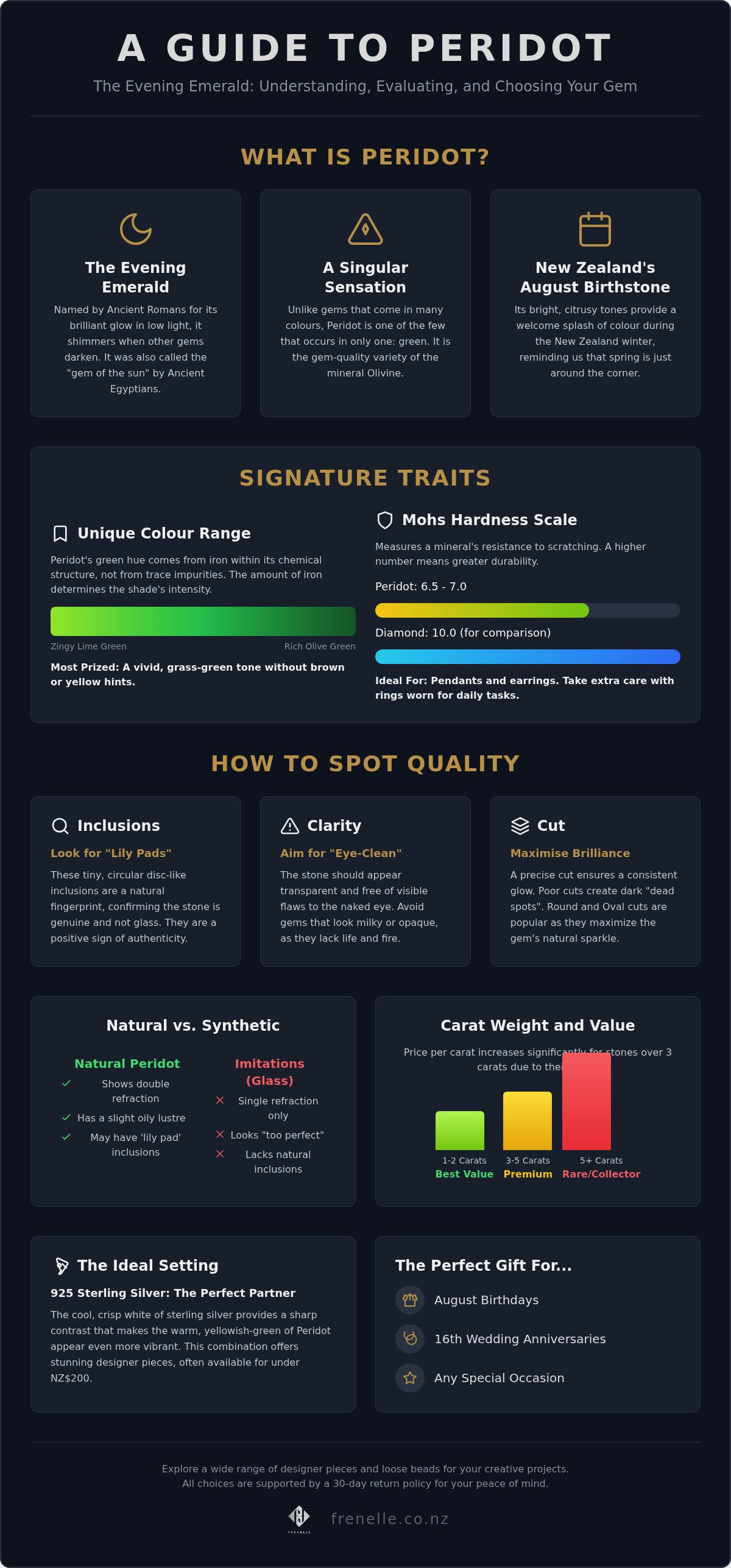
Iron is the secret behind the signature look of this gemstone. Unlike many other gems that get their colour from trace impurities like chromium or vanadium, the green in peridot comes from its basic chemical composition. The amount of iron present determines the exact intensity of the hue. You'll find a wide range of shades available, from a light, zingy lime green to a deep, rich olive. The most prized specimens are often those with a vivid, grass-green tone that lacks any hint of brown or yellow. Because it's idiochromatic, you can always trust that the colour is consistent throughout the entire stone.
When choosing a piece for your collection, it's helpful to understand how durable the stone is for your lifestyle. On the scale used by jewellers to measure mineral hardness, this gem sits between 6.5 and 7. (Mohs hardness rating is from 1 to 10, with 10 being diamond) A rating of 7 means it's durable enough for beautiful statement pendants or 925 sterling silver earrings that won't see much physical contact. However, if you're wearing it in a ring for daily tasks, you should take a little extra care. It's a slightly softer stone than a sapphire or diamond, so removing your rings before gardening or heavy cleaning will ensure the facets stay crisp and scratch-free for years to come.
Selecting a high-quality stone involves looking past the initial sparkle to see what is happening inside the crystal. Unlike many other gemstones where inclusions are seen as a negative, natural peridot often contains unique internal markers known as lily-pads. These are small, circular disks that look like tiny lily pads floating in a clear pond. While large, distracting flaws will lower the value, these specific markers are actually helpful. They act as a fingerprint, confirming the stone was created by nature rather than being a piece of green glass or a synthetic imitation.
Clarity is another vital factor to consider. Most buyers prefer eye-clean stones, which means that when you look at the jewellery from a normal distance, you can't see any internal marks with the naked eye. Because this mineral is more abundant than emeralds, you don't have to settle for heavily clouded stones. You should look for a crystal that appears bright and transparent. If a stone looks milky or opaque, it won't have the same life and fire when it catches the light.
The way a gem is shaped changes how it interacts with light. Round brilliant and oval cuts are the most popular choices because they maximize the natural light refraction of the stone. A well-cut gem will have a consistent glow across its entire surface. If the cut is too shallow or too deep, you might see dark "dead" spots in the centre of the stone where light is leaking out the back. A precise cut ensures that the lime-green colour remains vibrant from every angle, reinforcing that evening emerald glow we discussed earlier.
One clever trick for spotting a real gem is looking for double refraction. In larger stones, if you look through the top facet, you might see the edges of the back facets appear as double lines. Synthetic glass or cheap plastic imitations won't show this effect. If a stone looks absolutely perfect and lacks the slight oily lustre characteristic of the mineral, you should be cautious. Shopping with a dedicated New Zealand boutique that understands these nuances is the best way to ensure you are investing in an authentic piece of jewellery.
Peridot is quite unique because it's relatively abundant in smaller sizes. This keeps prices stable and affordable for the stones typically used in earrings or delicate pendants. However, the market changes once you look for stones over three carats. These larger crystals are much harder to find in a clean, vibrant state, so the price per carat increases significantly. For most shoppers, the sweet spot for value is usually between one and two carats. This size offers enough presence to show off the stunning green colour without reaching the premium prices of rare collector-sized stones.
Selecting the right metal for your jewellery is about more than just personal preference; it's about how the frame interacts with the stone's unique green hue. In New Zealand, many shoppers find that 925 sterling silver is the perfect partner for this gemstone. The cool, crisp white of the silver provides a sharp contrast to the warm, yellowish-green of the stone. This makes the gem appear even brighter and more vibrant. If you prefer a more traditional or luxurious look, 18K gold plating is an excellent alternative. The yellow gold tones harmonize with the iron-rich green of the stone, creating a softer, sunnier aesthetic that feels high-end while remaining budget-friendly.
The choice of metal also influences how the shade of the stone is perceived. A lighter lime-green stone can sometimes look washed out against very pale metals but glows warmly when surrounded by gold. Conversely, a deep olive stone looks modern and sophisticated when set in silver. Because we focus on providing an accessible boutique experience, we ensure our wide range of settings caters to both styles. This allows you to find a piece that perfectly matches your existing collection without needing to spend thousands of dollars.
Sterling silver is particularly popular for earrings and pendants due to its hypoallergenic properties. If you have sensitive ears, 925 sterling silver is a reliable choice that minimizes the risk of irritation. For necklaces and earrings, silver is also exceptionally durable. Since these pieces don't experience the same bumps and scrapes as a ring, a silver setting will maintain its polished finish for years with minimal maintenance. Many customers choose to purchase matching sets of earrings and pendants to create a cohesive fashion statement for special events like weddings or landmark birthdays. It's an easy way to elevate an outfit while staying within a budget of NZ$200.
While peridot is a beautiful choice for a ring, the setting requires a bit more thought than a diamond or sapphire. As we discussed earlier, the stone has a hardness of 6.5 to 7 on the Mohs scale, which means it can be susceptible to scratches if it's hit against hard surfaces. A bezel setting, which wraps a thin band of metal entirely around the edge of the stone, offers the best protection. It guards the gem against chips and keeps it secure. Prong settings are also popular and allow more light to enter the stone, but they leave the edges more exposed. If you choose a prong-set ring, it's best to reserve it for special occasions rather than heavy daily wear to keep the gemstone in pristine condition.
Gifting peridot is a wonderful way to celebrate specific life milestones. While many people know it as the August birthstone, it's also the traditional gift for a 16th wedding anniversary. Giving a piece of jewellery with this stone isn't just about the colour; it's about the history and meaning behind it. Ancient cultures believed it brought strength and balance to the wearer, making it a thoughtful gesture for someone embarking on a new journey. In New Zealand, the bright green hue provides a refreshing contrast to the grey skies of a typical August winter.
Because Frenelle is a founder-led business based in New Zealand, there's an added layer of meaning when you choose our pieces. Many of our gemstone items are designed and made by Judy Wood herself. Receiving a piece crafted by a local artisan feels more personal than a mass-produced item from a global chain. It reflects a sense of accountability and pride that we bring to every order. This connection between the maker and the wearer adds a special emotional value to the gift that goes beyond the physical object.
August is a unique month in the birthstone calendar because it has multiple associated gems, but peridot remains the most iconic choice. For those looking to create a more complex story, this green gem pairs beautifully with other stones like amethyst or clear quartz. Mixing these can represent different family members or specific shared memories, turning a simple necklace into a wearable family tree. This approach is perfect for milestone birthdays where you want the gift to tell a specific story that is unique to the recipient.
To keep your pieces looking their best, you don't need expensive equipment. In fact, you must strictly avoid ultrasonic cleaners. These machines use high-frequency sound waves that can sometimes damage the internal structure of the stone, especially if it has the signature lily-pad inclusions we discussed earlier. Instead, use mild dish soap and warm water with a soft cloth. This gentle method is the safest way to maintain the stone's glow without risking any structural damage.
Proper storage is just as vital as cleaning. When you aren't wearing your jewellery, store it in a separate pouch or a lined box. Harder gemstones like diamonds or sapphires can easily scratch the surface of your peridot if they are left together in a shared container. By taking these simple steps, you'll ensure your pieces remain a beautiful part of your collection for many years. Ready to find a meaningful gift? You can browse our wide range of gemstone jewellery to find the perfect piece for your next celebration.
At Frenelle, we believe that the vibrant energy of peridot should be accessible to everyone, whether you're looking for a finished piece to wear tonight or the raw materials to create something of your own. Our online boutique features a wide range of jewellery specifically designed for the New Zealand lifestyle. We focus on pieces that transition easily from a casual brunch in Napier to a formal evening event in Wellington. By combining natural gemstones with durable 925 sterling silver and high-quality 18K gold plating, we offer the luxury feel of a high-end boutique without the exclusionary price tags.
Our collection is curated with an eye for both beauty and value. Because Judy Wood designs and makes many of these pieces herself, there's a level of personal care in every selection. You'll find everything from minimalist stud earrings to intricate statement pendants that highlight the stone's unique olive glow. Every item in our store is currently available for purchase, ensuring that what you see online is what will arrive at your door. We've worked hard to create a shopping experience that feels like visiting a local boutique, even though we operate exclusively online.
We started offering loose gemstone beads because we noticed a growing community of DIY enthusiasts across New Zealand who wanted to create their own unique designs. Whether you're a seasoned maker or a beginner just starting your journey, having access to genuine peridot beads allows you to experiment with different textures and patterns. We provide a variety of sizes and shapes to suit any project, from delicate bracelets to bold, multi-stone necklaces. For those new to the craft, we recommend starting with simple stringing projects using our magnetic clasps to get a feel for how different stones sit together. It's a rewarding way to build a collection that is entirely your own.
We understand that buying jewellery online requires a high level of trust. That's why we offer a 30 day return policy on all our items. If a piece arrives and it's not quite what you expected, you can return it with total peace of mind. We pride ourselves on being a dependable local business, providing fast delivery within 2 to 5 working days to any address in the country. We invite you to explore our full gemstone collection and discover the perfect piece to celebrate your next milestone or creative spark. If you have any questions about our peridot range, we're always here to help you find exactly what you're looking for.
Choosing a piece of peridot jewellery is about more than just finding a beautiful colour; it's about connecting with a stone that carries a rich history of strength and balance. You now have the tools to identify the signature lily-pad inclusions of natural stones and select settings that protect your investment. By opting for the 925 sterling silver quality we offer, you ensure your new treasure stays vibrant and safe for sensitive skin.
Every piece in our wide range is designed by Judy Wood with the New Zealand lifestyle in mind. We want you to feel completely confident when shopping with our boutique, which is why we provide a 30 day return policy for total peace of mind. Whether you're treating yourself or finding a milestone gift for a loved one, these lime-green gems are ready to light up your collection. Take the next step in your jewellery journey today and Browse the Full Peridot and Gemstone Collection. We look forward to helping you find a piece that truly shines.
Peridot is a natural, real gemstone. It is the gem-quality variety of the mineral olivine. While it has a crystalline structure like many minerals, it's classified as a semi-precious gemstone and is one of the few gems that only occurs in one colour. Its volcanic origins and unique chemical makeup make it a distinct and valuable addition to any jewellery collection.
You can wear your ring daily, but it requires a bit of extra care compared to harder stones like diamonds. With a hardness of 6.5 to 7 on the Mohs scale, it's durable enough for regular wear if you're mindful. It's a good idea to remove your ring before doing dishes, gardening, or hitting the gym to prevent accidental scratches or chips to the stone.
The safest cleaning method is using warm water mixed with a few drops of mild dish soap. Use a soft cloth or a very soft toothbrush to gently wipe away any oils or dirt. Always avoid using ultrasonic or steam cleaners, as the heat and vibrations can cause the stone to crack. Rinse your jewellery thoroughly in clean water and pat it dry with a lint-free cloth.
This nickname comes from the stone's ability to glow brilliantly even under artificial light. Ancient Romans noticed that while other green gems seemed to darken as the sun went down, this stone stayed vibrant. Because it looks just as green by lamplight as it does in the sun, it earned its reputation as the emerald of the evening.
Historically, this stone has symbolized protection, strength, and balance. Ancient Egyptians called it the gem of the sun and believed it could ward off nightmares and evil spirits. In other traditions, it's thought to bring peace to relationships and help the wearer stay calm during stressful times. Today, many people wear it as a symbol of personal growth and renewal.
No, it only occurs in shades of green. Unlike quartz or sapphire which can be many different colours, the green in this stone is part of its basic chemical structure. While the shade can range from a light lime green to a darker olive, you'll never find a natural version of this gem in blue, red, or yellow.
One of the best ways to verify a stone is to look for double refraction. If you look through the top of a larger stone, the back facets may appear as double lines. You can also look for tiny, disk-like inclusions known as lily-pads under a magnifying glass. These natural markers are rarely found in synthetic glass or plastic imitations.