Your Cart is Empty

Why would you pay hundreds of dollars for a "fake" diamond when another version costs less than a lunch in Auckland? It's often confusing to see two rings that look identical online but carry vastly different price tags. You likely want that high-end sparkle without the ethical baggage or the worry that your jewellery will tarnish quickly in our New Zealand humidity. We understand that finding the right balance between cost and quality is a priority for any savvy shopper.
In this 2026 guide, you'll discover exactly what you're paying for. You can choose affordable luxury with total confidence. We'll provide a clear Comparison/Alternative-Led: Moissanite vs. CZ vs. diamond, sterling silver vs. gold plate breakdown to show how different materials perform over time. By the end, you'll know which gemstones offer the best brilliance and which metals stay beautiful in your collection, ensuring you get the look you love at a price that makes sense.
High-end brilliance was once a luxury reserved for those with massive budgets. That is no longer the case for New Zealand shoppers. Today, you have incredible choices that offer the same fire and light as a traditional diamond without the financial strain. The shift toward lab-created stones has changed the jewellery landscape, providing ethical and sustainable paths for anyone who wants a stunning look without the environmental impact of earth-mining. Whether you are browsing for a daily-wear necklace or a special engagement ring, understanding the "Big Three" stones is the first step toward a confident purchase.
Shopping for jewellery online requires a high level of trust. You need to know exactly what you are adding to your cart. This Comparison/Alternative-Led: Moissanite vs. CZ vs. diamond, sterling silver vs. gold plate breakdown is designed to clear up the confusion. While diamonds remain a classic choice, Moissanite and Cubic Zirconia are the modern heroes for anyone seeking affordable luxury. It is vital to understand that while lab-grown diamonds are chemically identical to mined ones, Moissanite and CZ are technically Diamond Simulants. They mimic the look of a diamond but possess their own unique chemical structures and visual properties.
French scientist Henri Moissan first discovered this mineral in 1893 within a meteor crater. It is composed of silicon carbide. Because natural Moissanite is incredibly rare, almost all the stones you see in modern jewellery collections are lab-grown. This controlled process ensures perfect clarity and impressive stone sizes that would be prohibitively expensive in a natural diamond. Moissanite is exceptionally tough and has a higher refractive index than a diamond; it actually produces more "fire" or colourful flashes of light when it catches the sun.
Cubic Zirconia, or CZ, is a synthetic crystalline substance made from zirconium dioxide. It has been the world's most popular diamond alternative since the late 1970s. CZ is a simulant, not a synthetic diamond, meaning it mimics the visual appearance of a diamond rather than its carbon composition. It is the most accessible option for those who want a high-shine look on a friendly budget. Many of our CZ pieces are paired with high-quality 18K gold plating or 925 sterling silver. This combination provides a premium aesthetic that stays beautiful in the New Zealand climate, provided you follow basic care steps to protect the plated finish.
When you look at a gemstone, your eyes are reacting to how light moves through the material. This visual performance is what we call "sparkle," but it's actually made of two distinct parts: brilliance and fire. Choosing the right stone often depends on which of these effects you prefer. This Comparison/Alternative-Led: Moissanite vs. CZ vs. diamond, sterling silver vs. gold plate guide helps you decide if you want a classic icy look or a vibrant rainbow display. It's not just about aesthetics; you need a stone that can handle your lifestyle, especially if you're active or work with your hands.
Brilliance refers to the white light that bounces back to your eye. Diamonds are famous for this crisp, white sparkle. Fire is the dispersion of light into rainbow colours. Moissanite is the champion of fire with a refractive index of 2.65. This is significantly higher than a diamond's 2.42. In bright New Zealand sunlight, Moissanite can look like a tiny disco ball, throwing vivid flashes of red, blue, and orange across the room. Cubic Zirconia has a refractive index of 2.15. While it's slightly less intense than the other two, a high-quality CZ stone still offers a beautiful, clear sparkle that many people find indistinguishable from a diamond at a glance. If you love a bold, colourful light show, browsing moissanite jewellery is a great place to start.
Durability is the second half of the value equation. Many people believe only diamonds are tough enough for daily wear, but that is a common myth. We use the Mohs scale to measure a stone's resistance to scratching. A diamond sits at a perfect 10. Moissanite follows closely at 9.25, making it incredibly difficult to scratch and perfect for pieces like engagement rings that take a lot of knocks. Cubic Zirconia ranks between 8 and 8.5. While it's softer than Moissanite, it's still harder than most natural gemstones like emeralds or opals. For pieces like earrings or pendants that don't take much physical impact, a CZ stone will stay looking new for years. You can learn more about these ratings in our guide to What is Mohs Hardness? to see how your favourite gems stack up.
The secret to long-lasting jewellery isn't just the stone; it's how the stone is held. A durable stone in a poor-quality setting won't last. That is why we focus on pairing these brilliant stones with reliable metals like 925 sterling silver and 18K gold plating. This ensures your collection remains as sturdy as it is sparkling, no matter which stone you choose for your next digital order.
While the sparkle of a stone catches the eye, the metal base determines how often you'll actually wear the piece. A beautiful gem is only as good as the setting that holds it. In the New Zealand climate, with our salty air and high humidity, choosing the right metal is a practical decision as much as a stylistic one. This Comparison/Alternative-Led: Moissanite vs. CZ vs. diamond, sterling silver vs. gold plate guide helps you navigate these choices so your jewellery remains a staple in your collection for years rather than months.
Many shoppers feel overwhelmed by industry terms. It's important to understand that most high-quality fashion jewellery uses plating to achieve a specific look while keeping costs accessible. We focus on providing pieces that balance this affordability with durability. Your choice usually comes down to your skin's sensitivity, your preferred colour palette, and how much maintenance you're willing to do. Because we operate as an online boutique, we can offer these premium finishes without the traditional retail markups.
When you see the "925" stamp on our earrings or rings, it means the piece contains 92.5% silver. The remaining 7.5% is typically copper, which adds the necessary strength for daily wear. Pure silver is far too soft for functional jewellery, so this alloy is the global standard for quality. For those with sensitive ears, sterling silver is an excellent choice because it's generally hypoallergenic. If you live near the coast, you might notice your silver darkening over time. This tarnish is a natural reaction to sulphur in the air. A quick wipe with a specialised polishing cloth after a day at the beach will keep that cool, metallic shine bright.
If you love the warm, rich glow of gold, 18K gold plating is your best friend. This process involves bonding a layer of real 18-carat gold over a base metal, which is often our 925 sterling silver. We choose 18K because it offers a deeper, more authentic golden hue than lower-carat alternatives. It allows you to enjoy the aesthetic of high-end luxury without the heavy financial investment. To keep the finish looking fresh, avoid wearing your plated necklaces in the shower or swimming pools. Chemicals like chlorine can wear down the gold layer over time. Store your pieces in a dry place when you aren't wearing them to preserve that "just-bought" radiance.
Finding your perfect match depends on your skin's undertones and your personal lifestyle. Cool undertones often look best with the crisp white of sterling silver, while warm undertones are beautifully complemented by 18K gold. When browsing our digital collections, you can select pieces that fit your wardrobe perfectly. Whether you choose the lasting nature of 925 sterling silver or the vibrant finish of 18K gold plating, you're investing in quality that stays beautiful in the unique Kiwi environment.
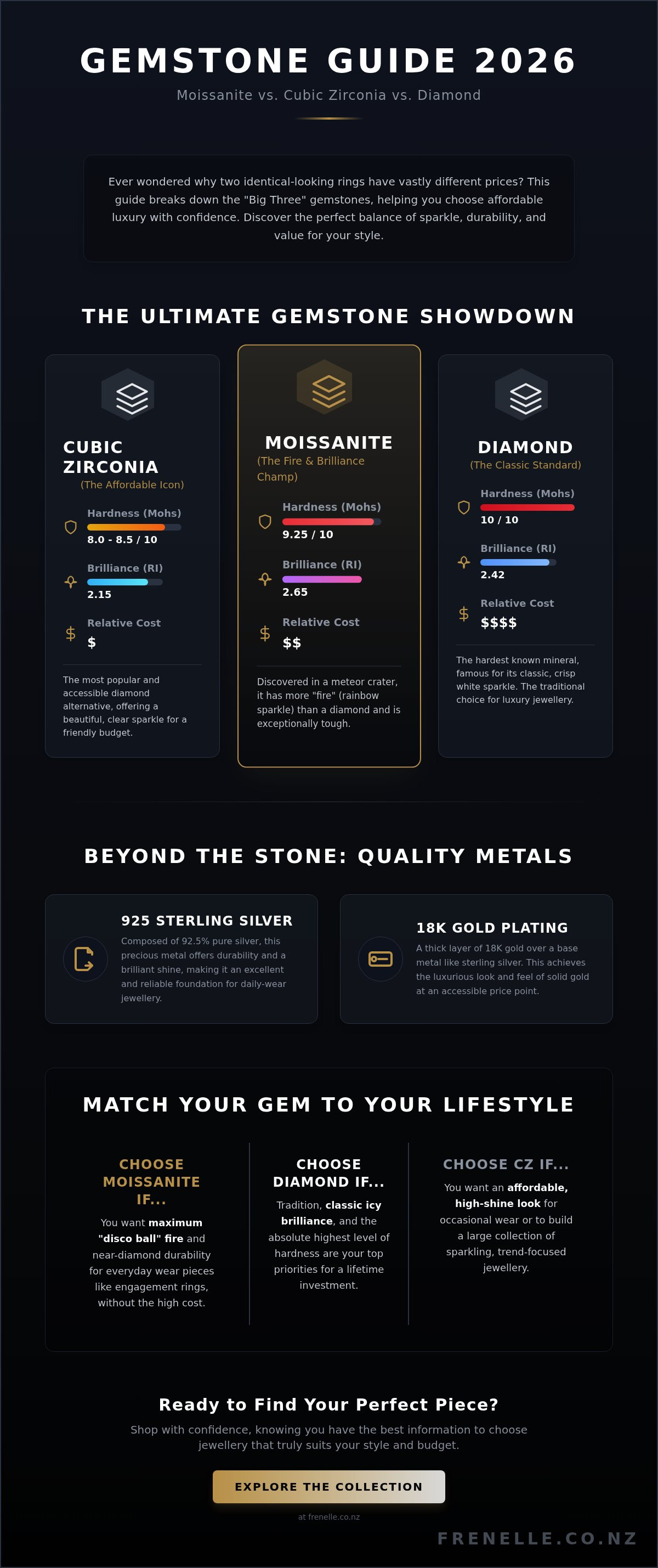
True value in jewellery isn't just about the initial price tag. It's about how much joy and use you get out of a piece over several years. While a natural diamond can cost between $5,000 and $12,000 for a single carat, lab-grown alternatives provide the same visual impact for a fraction of that investment. This Comparison/Alternative-Led: Moissanite vs. CZ vs. diamond, sterling silver vs. gold plate analysis shows that you can achieve a luxury look regardless of your starting budget. By understanding the price per carat differences, you can decide where to invest and where to save.
The price gap between these stones is significant. A high-quality one carat Moissanite typically ranges from $300 to $800 USD. In contrast, a Cubic Zirconia stone of the same size usually costs between $10 and $50. This means you can own a stunning, sparkling collection for the price of a single traditional diamond ring. For many New Zealanders, this shift allows for more variety in their jewellery boxes without compromising on the quality of the settings or the stones.
We recommend matching the stone to the occasion. Cubic Zirconia is the smarter choice for travel jewellery or bold statement pieces that follow a current fashion trend. If you lose a CZ earring while on holiday, it's easily replaced without heartbreak. Moissanite is the "splurge" option for "forever" pieces like pendants or engagement style rings because of its superior hardness. We often pair these stones with 925 sterling silver for items that get frequent use. This metal is durable and maintains its integrity through daily tasks better than many other affordable alternatives.
Modern shoppers often prioritise sustainability over tradition. Choosing lab-created stones means you're opting for a conflict-free product with a much smaller environmental footprint than earth-mined diamonds. There's no large-scale mining involved, which protects natural landscapes and ecosystems. Many Kiwi consumers now check for these ethical markers before they complete their online shopping. It's a way to enjoy beautiful things while staying true to your personal values. You can shop our ethical jewellery collections to find pieces that look good and feel good to wear.
Building a versatile jewellery wardrobe doesn't require a massive inheritance. By mixing high-quality CZ for trendy accessories and Moissanite for your core pieces, you create a collection that looks expensive but remains practical. Focus on pieces that use 18K gold plating or sterling silver bases to ensure your budget goes toward items that won't irritate your skin or lose their lustre after a few wears. This balanced approach to shopping ensures you're always prepared for both casual coffee dates and formal weddings.
Choosing the right jewellery shouldn't feel like a gamble. Now that you understand the technical differences between various stones and metals, you can shop with a clear strategy. At Frenelle Jewellery, we've spent years curating a collection that prioritises the "sweet spot" where high-end aesthetics meet realistic budgets. Our Comparison/Alternative-Led: Moissanite vs. CZ vs. diamond, sterling silver vs. gold plate philosophy ensures you always know exactly what you're paying for. We don't hide behind complex jargon; we provide the facts so you can choose the sparkle that fits your life.
Our commitment to transparency is what sets us apart in the New Zealand market. We understand the frustration of buying a piece online only to have it tarnish within weeks. That is why we are explicit about our materials. Whether it's a 925 sterling silver earring for sensitive skin or a vibrant 18K gold plated necklace for a wedding, we ensure the quality matches our descriptions. You deserve jewellery that stays beautiful in our local climate, and we've designed our entire inventory to meet that standard.
Operating exclusively as an online store allows us to cut out the massive overhead costs associated with physical high-street retail. We don't have expensive showrooms to maintain, so those savings go directly into the quality of our materials and the precision of our stone settings. You'll find 18K gold plating that is thick and rich in colour, alongside 925 sterling silver that stands the test of time. Our founder-led team hand-selects every piece, focusing on modern minimalist designs and classic bridal styles that resonate with New Zealand's unique fashion sense. Because you're shopping in a digital environment, we provide high-resolution photography and honest descriptions. You can see the facets of a Moissanite stone or the lustre of a freshwater pearl as if you were holding it.
We know that waiting for a package is the hardest part of online shopping. That's why we've streamlined our logistics to offer 2-5 working day delivery across New Zealand. Whether you're in a city centre or a rural township, your new favourite piece will arrive quickly and securely. We also understand that sometimes a piece doesn't look quite how you imagined once you try it on at home. Our 30-day return policy is designed to give you complete peace of mind. It's our way of ensuring you're 100% happy with your investment.
If you're ready to add a new level of brilliance to your collection, we invite you to explore our digital aisles. You can browse our moissanite and sterling silver collections today and find the perfect balance of durability and design. From adjustable rings to statement pendants, your next piece of affordable luxury is just a few clicks away. We're always here to help if you have any questions about our materials or delivery process, keeping our community at the heart of every interaction.
Choosing the right piece is about more than just looks; it's about finding a balance between lasting beauty and smart value. You now have the tools to navigate our Comparison/Alternative-Led: Moissanite vs. CZ vs. diamond, sterling silver vs. gold plate guide with ease. Whether you prefer the intense fire of Moissanite or the accessible shine of Cubic Zirconia, your collection can reflect your style without the traditional retail markup. Selecting a metal base like 925 sterling silver or 18K gold plating that suits your skin and the coastal air ensures your jewellery stays radiant for years to come.
As a founder-led NZ boutique, we take pride in offering quality you can trust. We understand the importance of security when shopping online. That is why we provide a 30-day money-back guarantee and fast 2-5 day national delivery on every order. It's time to treat yourself to affordable luxury that doesn't compromise on ethics or elegance. We are here to help you find that perfect balance of sparkle and durability.
Browse our curated Moissanite and Sterling Silver collections today and find your next favourite piece.
Moissanite is not a diamond; it is a distinct gemstone with its own unique chemical structure made of silicon carbide. While it closely mimics the look of a diamond, it is a standalone mineral that was originally discovered in a meteorite crater. In the Comparison/Alternative-Led: Moissanite vs. CZ vs. diamond, sterling silver vs. gold plate discussion, Moissanite is valued for being more brilliant and fiery than a diamond while remaining a more affordable and ethical choice.
High-quality cubic zirconia will not turn yellow, but it can appear discoloured if it isn't cleaned regularly. Over time, skin oils, soaps, and lotions can build up a film on the surface of the stone, making it look cloudy or dull. A quick, gentle clean with warm soapy water and a soft brush usually restores its original icy sparkle. Unlike cheap plastic imitations, CZ is chemically stable and maintains its clarity for years.
Most people find it impossible to tell the difference with the naked eye. Moissanite actually has a higher refractive index than a diamond, which means it produces more colourful rainbow flashes. This "fire" is especially visible in bright New Zealand sunlight. While a trained jeweller using a loupe can spot the difference, a casual observer will simply see a high-quality, brilliant gemstone that looks identical to a high-end diamond.
Yes, 925 sterling silver is an excellent choice for those with sensitive skin because it is generally hypoallergenic. It consists of 92.5% silver and 7.5% other metals, usually copper, for added strength. We ensure our sterling silver earrings don't contain nickel, which is the primary cause of most allergic reactions to jewellery. This makes it a safe, comfortable, and durable option for daily wear in our local climate.
Clean your gold-plated pieces using a very soft cloth and a gentle solution of warm water mixed with a drop of mild dish soap. Avoid using abrasive jewellery cleaners, chemical dips, or rough scrubbing, as these can wear down the 18K gold layer over time. Always pat your jewellery dry with a lint-free cloth after cleaning. Storing your pieces in a dry, airtight pouch when you aren't wearing them also helps preserve the finish.
Moissanite is the best diamond alternative for an engagement ring because of its exceptional hardness. It ranks 9.25 on the Mohs scale, which is second only to a diamond. This makes it tough enough to handle the daily knocks and scratches that come with a ring you wear every day. While cubic zirconia is a beautiful and budget-friendly choice for earrings or pendants, Moissanite offers the long-term durability required for a "forever" piece. For those seeking high-quality natural alternatives, AfricaGems provides a vast array of loose gemstones like sapphires and emeralds that are also perfect for lasting jewellery.
Yes, Moissanite will often pass as a diamond on a basic thermal diamond tester. These devices measure how heat moves through a stone, and because Moissanite and diamonds conduct heat in a very similar way, the tester may give a positive result for a diamond. To accurately tell them apart, a specialised tester that measures electrical conductivity is needed. This technical similarity is a testament to the high quality and performance of Moissanite.
Moissanite costs more because the lab-growing process is much more complex and energy-intensive. Creating large, clear silicon carbide crystals takes more time and specialised equipment than producing zirconium dioxide for CZ. This higher price reflects the stone's superior durability and its more realistic diamond-like brilliance. It occupies a premium position in the Comparison/Alternative-Led: Moissanite vs. CZ vs. diamond, sterling silver vs. gold plate spectrum for those seeking the ultimate balance of value and longevity.