Your Cart is Empty

You might think a higher price tag automatically means your jewelry is bulletproof, but the truth about gemstone survival is hidden in the Mohs hardness scale. We all want our favorite pieces to look as brilliant in five years as they do today. It’s a common worry that a beautiful ring might lose its luster or pick up visible scuffs just from daily wear. At Frenelle, we believe you shouldn't have to guess whether your new treasure will stand the test of time.
This guide explains exactly how these ratings, first established in 1812, dictate which gems can handle the daily hustle of New Zealand life and which ones need a bit more care. You'll gain the clarity needed to buy with confidence from our online collection. We're going to break down the scale for popular, affordable choices like moissanite and cubic zirconia. This ensures you can select stunning, durable pieces that maintain their sparkle without the high-end price tag. By the end, you'll know exactly how to protect your plated jewelry and keep those stones shining for years.
When you browse the online collection at Frenelle Jewellery, you'll notice various gemstones like Moissanite and Cubic Zirconia. To choose a piece that lasts, you need to understand Mohs hardness. This system isn't about how "tough" a stone is against a hammer blow. Instead, it measures scratch resistance. In 1812, German geologist Friedrich Mohs developed this qualitative scale to rank minerals from 1 to 10 based on their ability to resist being scratched by another material.
It's vital to distinguish between scratching and breaking. A diamond is the hardest natural substance on Earth, sitting at a 10 on the scale, but it isn't indestructible. Hardness refers to the surface integrity. A "hard" stone won't get scuffed by everyday contact, while "toughness" refers to a stone's ability to resist chipping or fracturing. Because most of our beautiful pieces feature high-quality gold or silver plating, choosing a stone with a high hardness rating ensures the focal point of your jewellery remains clear and brilliant for years.
The scale operates on a simple principle: a material with a higher number can scratch anything lower than it. For example, your fingernail has a hardness of about 2.5, meaning it can't scratch a copper coin (3.0). A steel nail usually sits around 6.5. Scientific resources like the Mohs scale of mineral hardness provide the full breakdown of these mineral benchmarks.
A 7 is the magic number for anyone buying jewellery in 2026. This is because quartz, a common mineral found in everyday dust and grit, has a hardness of 7. If your gemstone ranks lower than this, the microscopic quartz particles in the air will slowly sand down the facets of your stone. This process eventually turns a once-sparkling gem into a dull, cloudy pebble.
New Zealanders love the outdoors. Whether you're hiking in the Waitakere Ranges or walking along a windy Auckland beach, your jewellery faces environmental challenges. NZ sand is often rich in quartz and volcanic grit. If you're wearing a ring with a soft stone while gardening or at the beach, that grit acts like sandpaper against the gem.
We recommend choosing stones with a Mohs hardness of 7 or higher for rings, as hands are the most active part of the body. Harder stones like Moissanite (9.25) or Cubic Zirconia (8.5) maintain their "fire" and brilliance because their surfaces remain smooth. A smooth surface allows light to enter and reflect perfectly. By shopping our online boutique, you can find durable, affordable alternatives to traditional gems that stand up to the rugged Kiwi lifestyle without losing their shine. Buy with confidence knowing your selection is built for daily wear.
Choosing the right stone for your jewellery involves more than just picking a pretty colour. You need to know how it stands up to daily life in New Zealand, whether you're gardening in Auckland or heading to a busy office. The Mohs Hardness Scale provides a practical way to measure this durability by ranking minerals from 1 to 10 based on their scratch resistance. At Frenelle, we focus on stones that offer the best balance of beauty and longevity for our online shoppers.
Diamonds sit at a perfect 10 on the scale, making them the hardest known natural substance. However, moissanite trails just behind at 9.25. This small numerical difference is almost indistinguishable in daily use. While a diamond is the traditional choice, moissanite has become the ultimate selection for affordable, lifelong jewellery because it doesn't cloud or scratch over time. It's a fantastic way to get that high-end look on a New Zealand budget without compromising on quality. Moissanite’s 9.25 rating on the Mohs scale ensures it remains a "forever" stone that can withstand the rigours of a lifetime of wear.
The durability of your jewellery isn't just about the stone's rating; it's also about how it's cut. Different gemstone shapes can influence the perceived durability and safety of a stone. For a Cubic Zirconia with an 8.5 hardness, a round or oval cut is often safer than a marquise or pear shape. These rounded edges help protect the stone from chipping if you accidentally knock your hand against a hard surface.
Cubic Zirconia offers a brilliant balance between an affordable price point and reliable hardness. Because we use high-quality CZ set in gold or silver plated mountings, you get the look of luxury with the convenience of an online boutique experience. If you're looking for a piece that combines this durability with a style that suits your personality, feel free to explore our collection of carefully selected designs.
The biggest misconception in the jewellery world is that "hard" stones are indestructible. While a diamond sits at the top of the Mohs Hardness Scale, it isn't immune to damage. Hardness only measures a mineral's resistance to being scratched. It doesn't account for "toughness" or "tenacity," which is a stone's ability to resist chipping, cracking, or breaking under impact.
Think of it this way: a diamond can only be scratched by another diamond, but it can still shatter into pieces if it hits a granite benchtop at the wrong angle. This happens because Mohs hardness focuses entirely on the surface. It doesn't tell you anything about the internal atomic bonds that hold the crystal together. You might have a stone that is difficult to scratch but very easy to break.
Every gemstone has an internal structure. Some have "cleavage planes," which are essentially built-in weak spots where the stone can split cleanly. Diamonds have perfect cleavage in four directions. If you drop a diamond ring on a tile floor in your Auckland home, that impact could hit a cleavage plane and cause a structural crack. Interestingly, moissanite often shows better toughness than diamond in lab impact tests because it lacks these specific cleavage directions. To keep your jewellery safe, avoid wearing high-Mohs stones during heavy housework or gym sessions. Even a 9 or 10 rating can't save a stone from a heavy, well-aimed blow.
At Frenelle, we focus on providing quality pieces that balance beauty with durability. Most of our range features 925 sterling silver plating, which acts as a protective "cradle" for your gems. This plating provides a secure environment for the stone to sit in. High-hardness stones like cubic zirconia or moissanite are much safer in prong settings because they can withstand the pressure required to hold them tight without crushing.
You should manage your expectations regarding the metal versus the stone. While your gemstone might resist every scratch, the silver-plated setting is naturally softer and will show signs of wear over time. This is a normal part of owning plated jewellery. Using a secure setting ensures that even if the metal takes a knock, the stone remains safely housed within the piece. Choosing the right setting for the right Mohs hardness level helps your jewellery last through years of daily wear.
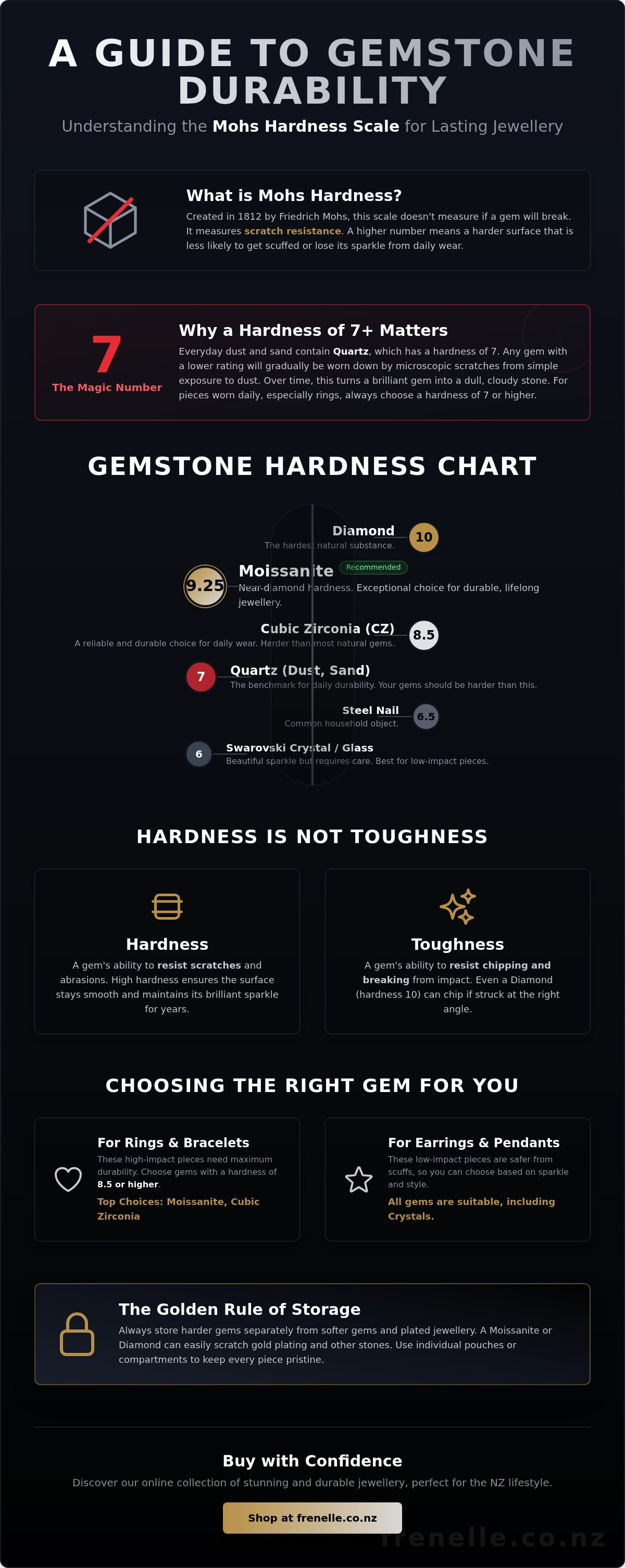
Selecting the right piece of jewellery involves more than just picking a pretty design. You need to consider how the piece fits into your daily life. A stone's position on your body determines the level of "wear and tear" it will face. By using the Mohs hardness scale as a guide, you can ensure your investment looks beautiful for years rather than months.
Rings and bracelets are high-impact items. Your hands are busy; they knock against car doors, kitchen benches, or office desks. For these pieces, aim for a stone with a rating of 8 or higher. Moissanite is a standout choice here with a rating of 9.25. It's tough enough to handle the rigours of a busy New Zealand lifestyle, from gardening in the Waikato to commuting in Auckland, without picking up unsightly surface scratches.
Earrings and pendants sit in low-impact areas. They rarely collide with hard surfaces, usually only touching your skin or soft fabrics. You can safely choose stones with a Mohs hardness of 6 to 7 for these items. This lower requirement opens up a world of affordable, vibrant options that don't need the extreme durability of a ring stone.
Moissanite has become the gold standard for travel jewellery and daily wear. It provides the fire and brilliance of a diamond while offering incredible resilience. Many of our customers choose Moissanite for overseas trips or beach holidays. It gives you a high-end look without the stress of carrying expensive heirloom diamonds through airport security.
Hardness directly affects the long-term quality of an earring. A stone that resists scratches stays clear and brilliant, which keeps the entire piece looking premium. Our Moissanite and Cubic Zirconia earrings are selected for this exact durability. We also offer clip-on styles designed for all-day comfort. Because these stones rank high on the scale, the facets stay sharp and the light continues to dance, even with frequent handling.
We focus on 18K gold plating and silver plating to provide a luxury aesthetic at an accessible NZ$ price point. It's a common misconception that you need solid gold for a piece to last. A hard stone like Moissanite actually protects the look of plated jewellery. Since the stone doesn't dull or scratch, the entire piece maintains its "brand new" shine. We value material honesty and provide clear descriptions so you know exactly what's in your collection. You get the look you love with the transparency you deserve.
Ready to find a piece that matches your lifestyle? Browse our collection of durable Moissanite jewellery today.
Understanding the Mohs hardness scale is only half the battle. Once you've selected a durable stone, you need to protect it from its own strength. The golden rule of jewellery storage is that harder materials always scratch softer ones. While a moissanite stone is incredibly resilient, its high rating means it can easily damage the metal plating of your other favourite pieces if they're left to rattle around together.
Many New Zealanders make the mistake of tossing their daily rings and earrings into a shared decorative bowl at night. If you place a moissanite ring next to a silver-plated bracelet, you're essentially putting a cutting tool next to a soft surface. Since 925 sterling silver plating typically ranks between 2.5 and 3 on the hardness scale, the 9.25 rating of moissanite will leave permanent marks on the metal with very little pressure. Keeping these items isolated is the best way to ensure your collection looks new for years to come.
At Frenelle, we recommend using a dedicated jewellery case with individual, soft-lined compartments. This isn't just about organisation; it's about physical protection. Our travel organisers are designed to prevent stone-on-stone friction, which is particularly vital when you're on the move between Auckland and the rest of the country. A good nightly routine involves a three-step checklist: wipe the piece with a soft cloth, check the stones are secure, and place it in its own fabric-lined slot. This simple habit prevents 100% of accidental contact scratches.
Cleaning high-hardness gems doesn't require industrial chemicals or abrasive pads. In fact, using harsh scrubbers can damage the 925 sterling silver plating that gives our jewellery its premium finish. Because moissanite and high-quality cubic zirconia are so high on the Mohs hardness scale, they don't trap dirt as easily as softer, porous stones like opals. A gentle soak in warm water with a drop of mild dish soap is usually all that's needed to restore that signature sparkle.
Avoid using "silver dips" or heavy polishing pastes on plated items, as these can strip away the protective layers over time. Stick to soft microfibre cloths to dry your pieces after cleaning. If you're ready to add a new, resilient piece to your wardrobe, you can browse our full collection of durable jewellery online. We focus on providing high-quality, beautiful designs that offer the look of luxury with the practical durability needed for everyday wear in New Zealand.
Choosing the right stone involves more than just picking a pretty sparkle. By understanding Mohs hardness, you can select gems like moissanite, which boasts a 9.25 rating, or cubic zirconia at 8.5, ensuring your jewellery resists daily scratches. While these numbers guide durability, remember that hardness is about surface protection; treating your plated sterling silver pieces with care will keep them looking new for years to come.
At Frenelle, we have spent over 10 years as a family-owned NZ boutique helping customers find the perfect balance of beauty and value. Our online store offers premium moissanite and cubic zirconia at affordable wholesale prices. You can browse our curated digital catalog from the comfort of your home, knowing every purchase is backed by our 100% satisfaction guarantee. We are proud to be an Auckland based business dedicated to providing high-quality, accessible jewellery for every occasion.
Shop our collection of durable Moissanite and Sterling Silver jewellery
We look forward to helping you find a piece that brings a little extra light to your day.
The number 10 is the highest rating on the Mohs scale, a position held exclusively by diamonds. This rating signifies that diamonds are the hardest natural substance on Earth. Because they sit at the very top, only another diamond can scratch a diamond's surface. For our customers browsing our online collections, this makes diamond-set pieces the most resistant to surface wear over many years.
Moissanite is not harder than a diamond, though it's the second hardest gemstone used in jewellery today. It holds a rating of 9.25, while a diamond is a perfect 10. This high Mohs hardness means moissanite is exceptionally durable and more resistant to scratching than sapphires or rubies. It's a fantastic, high-quality choice for those who want a brilliant stone that stands up to the rigours of daily life.
Cubic zirconia is unlikely to be scratched by most household items because it ranks between 8 and 8.5 on the scale. Common objects like steel keys, copper coins, or glass only reach a 5 or 6, so they won't damage the stone. However, since household dust can contain quartz particles with a rating of 7, we recommend storing your plated CZ jewellery in a soft pouch. This simple step keeps the facets looking sharp and clear.
A low rating means the gemstone is more susceptible to surface scratches and may lose its polish or "fire" over time. Stones like pearls (2.5) or opals (5.5 to 6.5) require much more care and shouldn't be worn during heavy tasks or cleaning. If a stone falls below a 7, even the microscopic silica in common dirt can dull the surface. This is why we prioritise durable, high-rated stones in our e-commerce store.
A rating of 7 is the absolute minimum for daily wear, but it's often better to aim higher for an engagement ring. Since quartz is a 7 and is found in everyday dust, stones like amethyst or citrine can slowly lose their lustre after years of constant use. For a ring intended to be worn every day for decades, we suggest choosing stones with a Mohs hardness of 8 or higher, such as moissanite or cubic zirconia.
We don't recommend testing the hardness of finished jewellery at home because the process requires intentionally trying to scratch the stone. Professional gemmologists use "hardness picks" tipped with minerals of specific ratings to see which one leaves a mark. Since this can permanently ruin a beautiful plated piece, it's safer to rely on the accurate material descriptions we provide for every item in our online shop.
Harder gemstones don't necessarily resist breaking better than softer ones because hardness only measures scratch resistance, not impact resistance. This second quality is known as "toughness." A diamond is the hardest mineral at 10, yet it has a crystalline structure that can chip if it's hit at a specific angle. Even the hardest stones in our collection should be treated with care to avoid hard knocks against stone or metal surfaces.
Dust can scratch certain stones and metals because it often contains tiny particles of quartz, which sits at a 7 on the scale. If your gemstone or the metal plating on your jewellery is lower than a 7, these particles act like fine sandpaper when you wipe the surface. This is why we advise our New Zealand shoppers to rinse their jewellery with water to remove grit before wiping it with a soft, clean cloth.