Your Cart is Empty

Imagine you are getting ready for a birthday dinner in Auckland, reaching for your favourite ring, only to have the band snap right in your hands. It is a heartbreaking moment that many of us have faced, often leaving us wondering why a piece we cherished suddenly failed. This common issue is usually caused by metal fatigue, a process where repeated stress creates tiny, invisible cracks that eventually lead to a clean break. You are not alone in feeling frustrated when clasps become loose or your favourite accessories fail after only a few months of wear.
The good news is that understanding how these materials work can help you make smarter choices for your jewellery box. In this guide, we will explain exactly how metal fatigue impacts your accessories and what you can do to prevent it. You will learn how to identify high-quality materials like 925 sterling silver and moissanite that offer much better durability for daily wear. We also show you how to find beautiful, long-lasting pieces in the Frenelle sale collection, ensuring your next investment is both affordable and built to last through all of life's special milestones.
Most of us think of our jewellery as solid and unchanging, but metal is far more dynamic than it appears. When you wear a ring or a pair of earrings every day, the material is constantly reacting to the environment and your movements. Over time, this can lead to metal fatigue, which is the structural weakening of a material caused by repeated stress. It is the hidden reason why a piece that seemed perfectly fine yesterday might suddenly snap today without any obvious cause.
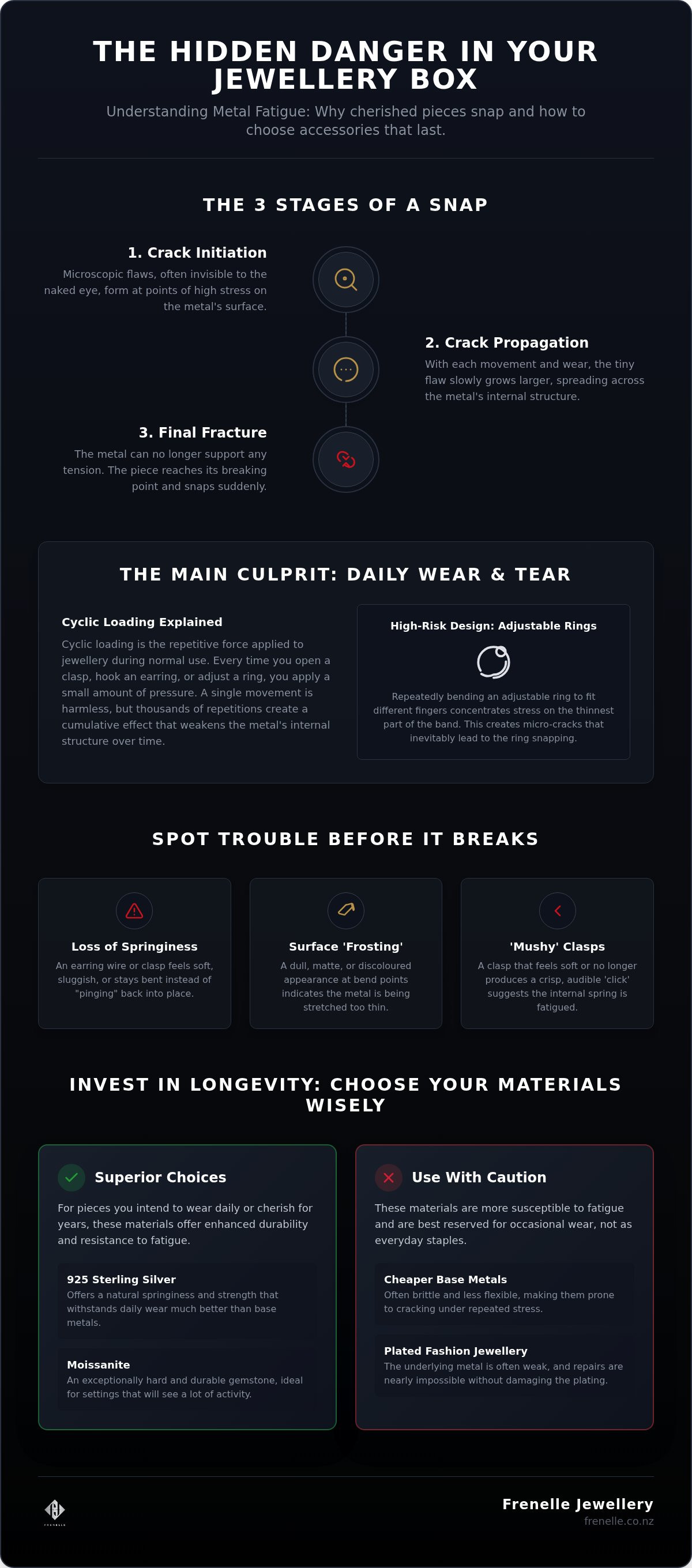
This process happens in three distinct stages that are often invisible to the naked eye. It begins with crack initiation, where a microscopic flaw forms at a point of high stress. As you continue to wear the item, you enter the crack propagation phase, where that tiny flaw slowly grows across the metal. Finally, the piece reaches a point where it can no longer support any weight or tension, resulting in a sudden fracture. For a comprehensive overview of material fatigue, scientific research shows that these failures often occur at stress levels much lower than what the metal is technically rated to handle. This is why even high-quality pieces can fail if they are mishandled or subjected to poor design choices that concentrate stress in one small area.
Cyclic loading is the repetitive force applied to a piece during daily wear. Every time you open and close a necklace clasp or hook a pair of 925 sterling silver earrings into your ears, you are applying a small amount of pressure. While a single movement won't cause damage, doing it thousands of times creates a cumulative effect on the metal's internal structure. Adjustable rings are particularly susceptible to this issue. Because they are designed to be "tweakable," many people bend them back and forth to fit different fingers. This repeated bending creates micro-cracks at the thinnest part of the band, which is why these items often snap right in the middle after a few months of use.
As these microscopic flaws grow into visible cracks over months or years, the metal undergoes physical changes. You might notice that a clasp or a band starts to feel "harder" or more brittle just before it fails. This happens because the metal's internal grains are being pushed to their limits, losing the flexibility they once had. It feels like a sudden accident when a band finally breaks, but the reality is that the metal has been slowly giving up for a long time. Once a crack starts in fashion jewellery, it is usually irreversible. Because these pieces are often delicate or plated, they cannot be easily welded or fused back together without causing further damage to the design. Choosing durable materials from the start is the best way to ensure your special anniversary or birthday gifts remain part of your collection for years to come.
Spotting the early warning signs of damage can save your favourite pieces from a total break. While we have discussed why these failures happen, you don't need a laboratory to see the results in your own collection. Look for "frosting" or a dull, matte appearance at the bend points of your rings or earring hooks. This discolouration suggests the metal is being stretched too thin. In coastal New Zealand areas like Auckland or Napier, the salt air and high humidity can accelerate surface wear, making these structural issues harder to spot under layers of tarnish. Understanding the microscopic mechanisms of metal fatigue helps us realise that what looks like a simple scratch might actually be the beginning of a deeper fracture.
Metal has a distinct "memory." It remembers every time you bend it or pull on it. High-quality materials like sterling silver have a natural springiness, but this elasticity fades over time as stress accumulates. You might notice a necklace chain that no longer hangs straight or an adjustable ring that feels soft and pliable rather than firm. These are clear indicators that the internal structure is compromised. Pay close attention to danger zones such as hinges on lockets, the thin under-gallery of rings, and the tiny jump rings that connect pendants to chains. These small connection points often bear the most weight and are the first to fail under the pressure of daily wear.
Regularly checking your accessories is the best way to prevent a sudden loss. You can use a simple magnifying glass to look for hairline fractures that aren't visible to the naked eye. Focus your attention on the following areas:
It is better to stop wearing a piece than to risk losing a precious pendant in the middle of a busy day. If a clasp starts to feel "mushy" rather than giving a crisp, audible click, the internal spring is likely fatigued. Similarly, if a jump ring has pulled into an oval shape, it is no longer secure. While some metals are tougher than others, everything has a limit. You can refer to our Mohs hardness guide to better understand how different materials stand up to daily life. If you notice these signs, it might be time to explore our latest collections for a fresh, durable replacement that you can wear with confidence.
Choosing the right material is your first line of defence against jewellery breakage. While all metals eventually experience wear, some are far better at resisting the microscopic damage that leads to failure. In the New Zealand market, we see a wide range of materials, but not all are created equal for longevity. Understanding the internal structure of your accessories helps you choose pieces that can withstand the rigours of daily life.
Metal fatigue behaves differently depending on the ductility of the material. Ductility is a metal's ability to deform under stress rather than snapping immediately. Precious metals like silver and gold are naturally more ductile than the cheap base metals like zinc or brass alloys often found in mass-produced fashion jewellery. Those cheaper alternatives tend to be brittle; they don't bend, they simply break. When you invest in better materials, you are essentially buying a higher fatigue limit, which is the level of stress a material can handle for a specific number of cycles before it fails.
925 sterling silver is a favourite for a reason. It's composed of 92.5% pure silver and 7.5% other metals, usually copper. This specific alloy is designed to improve strength without sacrificing the metal's natural beauty. One of the biggest advantages of silver is its high ductility. This means the metal can bend and stretch slightly before it breaks. In the context of metal fatigue, this flexibility allows your earrings or pendants to absorb more daily stress than cheaper, more brittle base metals. If a piece of silver jewellery develops surface stress, it can often be professionally polished to smooth out tiny imperfections, effectively hitting the reset button on its lifespan. This durability makes it a reliable choice for everyday wear in the New Zealand climate.
Many people assume that 18K gold plated necklaces are stronger because of the gold layer. However, plating is primarily an aesthetic choice and doesn't add structural integrity to the piece. A thick layer of gold can actually hide the early warning signs of metal fatigue, such as those hairline cracks we mentioned in the previous section. This is why the core material matters so much. Pieces that feature 18K gold plating over a sterling silver base offer the best of both worlds: the luxurious look of gold with the structural reliability of a precious metal core. It gives you the appearance of gold without the high price tag or the structural weaknesses of mystery base metals.
We also need to consider the seat where gemstones are placed. Whether you're wearing moissanite jewellery or cubic zirconia engagement rings, the tiny prongs holding the stone in place are under constant tension. If these prongs are caught on clothing or bent during cleaning, the metal undergoes stress. Over time, the prongs can become brittle and snap, leading to a lost stone. Choosing well-constructed settings from a trusted boutique ensures that your jewellery can handle the occasional bump without failing.
Finding a bargain is always satisfying, but finding a durable bargain is even better. When you shop our clearance section, you are not looking at lower-quality items. Instead, you are seeing end-of-line pieces that are making way for new designs in our Auckland boutique. This is the perfect opportunity to upgrade your jewellery box with materials that naturally resist metal fatigue without breaking your budget. By choosing specific designs, you can ensure your sale finds remain staples of your collection for years.
While we take pride in the quality of every item we stock, certain styles are naturally more robust than others. If you have experienced jewellery snapping in the past, use this sale to transition toward sturdier constructions. We want you to feel confident that your new accessories can handle the hustle of daily life, whether you are heading to work in Christchurch or enjoying a weekend in Queenstown. Remember that all sale items are final sale, so there are no refunds or returns on these clearance pieces.
Design plays a massive role in how well a piece stands up to repeated use. For daily wear, we recommend choosing solid geometric forms over very thin, spindly designs. Thicker bands on rings and more substantial links on chains distribute stress more evenly, which significantly reduces the risk of metal fatigue in the long run. If you are looking for earrings that you can wear comfortably every day, lever-back designs are an excellent choice. These provide a secure closure that reduces the hinge stress often found in traditional hooks.
We also suggest looking for moissanite pieces within our sale. Moissanite is known for its incredible hardness and durability, making it a "forever" gemstone. Our moissanite settings are crafted to provide maximum security for the stone, ensuring the prongs remain firm and resistant to the micro-cracks that can lead to a lost gem. These are ideal investments for anniversaries or special birthday celebrations where longevity is a priority.
The clearance section is a strategic way to stock up on gifts for upcoming milestones. You can find a wide range of 925 sterling silver pieces at outlet prices, allowing you to give a high-quality gift that lasts much longer than standard plated fashion jewellery. Because sterling silver is more ductile, it is less likely to snap unexpectedly, making it a reliable choice for your loved ones. Whether it is a graduation gift or a Christmas surprise, these pieces offer incredible value.
Ready to find your next favourite accessory? You can browse the clearance collection for durable bargains and discover high-quality jewellery that combines style with lasting strength. Our online store makes it easy to find exactly what you need from the comfort of your home.
Understanding the science behind why jewellery breaks is the first step toward building a collection that lasts. Now that you know how metal fatigue and repetitive stress impact your accessories, you can shop with a focus on longevity. Our clearance collection offers a unique opportunity for New Zealand shoppers to secure high-quality materials at accessible prices. By choosing pieces with superior structural integrity, you can enjoy the look of luxury without the worry of premature failure. Whether you are looking for a birthday gift or a treat for yourself, these selections combine aesthetic appeal with the durability your busy lifestyle demands.
We believe that every piece in your jewellery box should tell a story, not a tale of a broken clasp or a snapped band. Transitioning from mass-produced fashion items to well-crafted 925 sterling silver or moissanite is the most effective way to combat the long-term effects of metal fatigue. These materials are chosen specifically for their ability to handle the "cyclic loading" of daily wear, ensuring they remain as beautiful as the day you first put them on. While these items are part of our final sale range, their quality remains uncompromised, offering incredible value for those who value both style and substance.
Our clearance section features a wide range of sterling silver earrings that are perfect for those seeking timeless elegance. Because these pieces are 925 hallmarked, you can be certain they contain the correct alloy balance to provide both strength and ductility. We have classic silver hoops and minimalist studs that are designed to stand the test of time. These styles are particularly resistant to stress because they lack the complex moving parts or thin, spindly wires found in lower-quality alternatives. Choosing hallmarked silver ensures that your earrings can be polished and maintained for years, making them a reliable staple for any New Zealand wardrobe.
If you are looking for a piece that makes an impact, our statement pendants and necklaces offer both beauty and brawn. We focus on providing durable chains and secure clasps that won't let you down. Many of our sale items feature 18K gold plated finishes over sterling silver, giving you the rich glow of gold with a core that resists snapping. You will also find elegant designs incorporating freshwater pearl and cubic zirconia accents, adding a touch of sophistication to your look. These materials are selected for their ability to maintain their seat and security within the metal setting. We invite you to explore the full sale collection to find your next favourite piece and invest in jewellery that is built to celebrate all of your special milestones.
Understanding the science behind your favourite accessories changes the way you shop. You now know that metal fatigue isn't just a technical term; it's a real process that can be managed by choosing the right materials and designs. By prioritising the ductility of 925 sterling silver or the extreme durability of moissanite, you are investing in pieces that can handle daily wear without losing their structural integrity. We take pride in our role as an Auckland-based boutique, using our expertise to curate a wide range of accessories that offer both beauty and strength.
Regularly checking your jewellery for signs of stress ensures your most cherished gifts remain secure. Whether you are preparing for a wedding or looking for the perfect birthday surprise, our clearance collection provides an affordable way to upgrade to high-quality materials. It's time to move away from pieces that snap and embrace accessories that offer lifelong brilliance and reliability. We are here to help you find pieces that you can wear with confidence every single day, and if you want to extend that appreciation for quality to your decor, check out Fringe for original pop art and sculptures.
Shop the Frenelle Sale for Durable, High-Quality Jewellery Bargains
We look forward to helping you find your next favourite piece of jewellery that truly lasts.
Metal fatigue is the gradual structural weakening of a metal piece caused by repeated bending, pulling, or pressure. In your favourite accessories, this often happens when you open an earring hook or adjust a ring thousands of times. These repetitive actions create microscopic cracks that grow over time until the metal eventually snaps without any obvious cause.
Repairing metal fatigue in fashion jewellery is usually not possible or practical. Because the metal has become brittle at a molecular level, applying heat to solder the break often causes the area right next to the repair to fail. It's typically better to replace the item with a more durable piece from our 925 sterling silver range to ensure it lasts.
Precious metals like 925 sterling silver are highly resistant to snapping because of their natural ductility. This quality allows the metal to flex slightly under stress rather than cracking immediately. For those seeking maximum longevity, moissanite jewellery is another excellent choice as it features incredibly hard stones in robust, well-constructed settings.
You can tell an adjustable ring is nearing its failure point if the metal feels soft or "mushy" when you try to resize it. Look closely at the band for tiny horizontal lines or a dull, frosted patch where the metal is most frequently bent. If the ring no longer feels springy or firm, the internal structure has likely been compromised by repetitive stress.
Gold plating does not provide any structural protection against metal fatigue. While 18K gold plating offers a stunning finish and protects against surface tarnish, it's far too thin to add strength to the base metal. The durability of your jewellery depends entirely on the quality and thickness of the core metal underneath the plating.
Sale items with very thin, spindly designs are often more prone to breaking because they have less surface area to distribute daily stress. While these minimalist styles are beautiful, they don't handle "cyclic loading" as well as thicker bands or solid geometric forms. Choosing sturdier designs from our clearance section ensures you get an affordable piece that stays in one piece.
The best way to store your jewellery is flat in a soft-lined box where pieces cannot tangle or press against one another. In coastal New Zealand locations, keeping your accessories in an airtight pouch helps prevent salt air from accelerating surface wear. Avoid hanging heavy pendants on thin chains for long periods, as this can stretch and weaken the jump rings.
Yes, 925 sterling silver is much better at resisting fatigue than the brittle base metals found in cheap fashion accessories. The specific silver alloy is designed to be both tough and flexible, which is a perfect balance for items you wear every day. This flexibility allows the metal to absorb the shocks and bends of daily life without developing the deep cracks that lead to a break.