Your Cart is Empty

Have you ever spent ten minutes fumbling with a tiny lobster claw while you were already running late for dinner? It's a common frustration that can turn the simple act of getting ready into a test of patience. We know how it feels to worry about a precious necklace slipping off unnoticed or to struggle with a bracelet using just one hand. At Frenelle Jewellery, we believe the right jewellery clasps should bring you joy, not a headache. You deserve to feel secure and comfortable whenever you wear your favourite treasures.
Choosing the perfect closure is about more than just a functional connection; it's about protecting your investment and making your daily routine effortless. As an Auckland-based family business, Dennis and Judy Wood have curated this guide to help you discover which options offer the best security for 925 silver and gold-plated pieces. We'll also introduce easy-to-use solutions like magnetic clasps that allow you to buy with confidence, knowing your jewellery is both safe and simple to put on every morning.
A jewellery clasp is the functional fastener that ensures your necklace or bracelet stays secure on your body. While the gemstone or the metalwork often gets the spotlight, the clasp is the silent workhorse that protects your investment. Choosing the right one requires a careful balance between aesthetics, maximum security, and the physical ease of fastening the piece yourself. At Frenelle, we believe that a beautiful piece of jewellery should be as easy to wear as it is to admire.
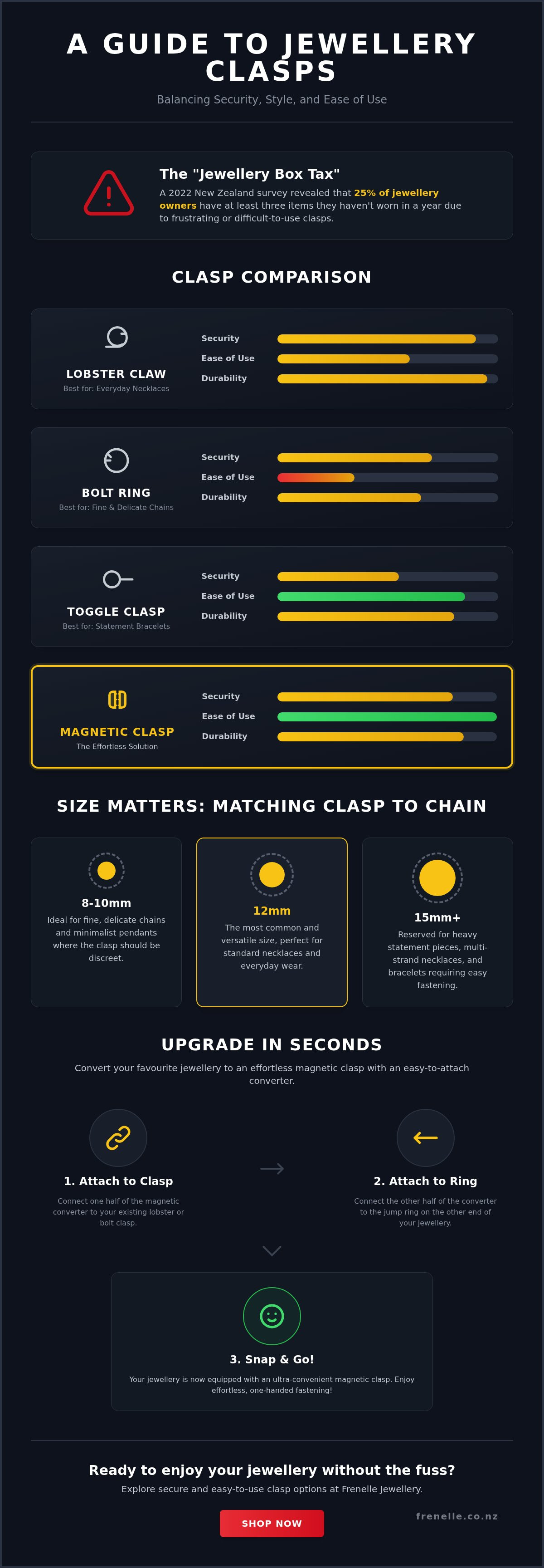
Many Kiwis suffer from what we call the "Jewellery Box Tax." This occurs when stunning necklaces or bracelets sit unworn for months because the clasp is simply too difficult to manage alone. A 2022 survey of 500 New Zealand jewellery owners revealed that 25% of participants had at least three items they hadn't worn in twelve months due to clasp frustrations. Beyond accessibility, you might consider upgrading your jewellery clasps to replace broken internal springs, improve the weight balance of a pendant, or to match a new metal tone after a piece has been replated.
Most traditional fasteners rely on three main components: the trigger, the spring, and the jump ring. The trigger is the small lever you pull back with your fingernail. This action compresses an internal steel spring, which provides the necessary tension to keep the mechanism closed. Understanding Jewellery chain materials and clasps helps you identify which metals offer the best durability for these high-friction parts. A jump ring is the essential connector for any clasp replacement. Different mechanisms, such as the lobster claw or the spring ring, offer varying levels of security based on how much the "arm" of the clasp overlaps with the closure point.
Matching the weight of your jewellery clasps to the weight of your chain is vital for both durability and comfort. If a clasp is too light, the daily tension of a heavy pendant can cause the metal to warp or the spring to fail. Conversely, a heavy lobster claw can ruin a delicate gold chain by pulling it out of alignment or causing it to sit awkwardly on the collarbone. Proportions matter just as much as the mechanical strength of the fastener.
In the New Zealand market, standard clasp sizes follow specific patterns to suit local tastes. You will typically find these sizes in use:
Identifying the correct size ensures that your jewellery looks intentional and stays exactly where it belongs. Whether you are repairing a family heirloom or customising a new find, the right clasp transforms a "sometimes" piece into a daily favourite.
Choosing the right fastener is about finding the sweet spot between security and ease of use. Different jewellery clasps serve different purposes, whether you're looking for something that stays put during a busy day in Auckland or something that's easy to put on with one hand. At Frenelle, we believe your jewellery should be as functional as it is beautiful.
Lobster claws are the industry standard for a reason. They feature a spring-loaded arm that's incredibly durable, making them the best choice for everyday necklaces. Their sturdy build ensures your jewellery stays safe even if the chain gets a little tug. If you're looking for something lighter, bolt rings (or spring rings) are common on fine 925 sterling silver chains in New Zealand. They're affordable and keep the focus on the pendant, though the tiny lever can be fiddly if you're in a rush.
For those who want a streamlined look, barrel clasps offer a hidden security feature. These fasteners consist of two metal cylinders that screw together. While they're very secure, they require a bit of coordination to align the threads; they're often better for necklaces than bracelets. When choosing a secure jewellery clasp, it's helpful to think about how often you'll be taking the piece off and on. A threaded fastener is excellent for security but takes a few extra seconds to manage.
Toggle clasps add a beautiful design element to any piece. They consist of a metal bar and a ring, working best on bracelets where the weight of the jewellery keeps the bar securely in place. On necklaces, they can sometimes come undone if the chain is too light, so they're usually reserved for chunkier statement pieces. If you prefer a vintage aesthetic, the hook and eye is a classic choice. It's simple and elegant, though it lacks the mechanical lock found in modern jewellery clasps.
Box clasps are the go-to for luxury items like tennis bracelets. A tab clicks into a box-shaped frame, often reinforced with a safety latch on the side. This dual-locking system provides peace of mind for your most precious items. If you're looking for something even more accessible, magnetic clasps are a fantastic alternative. They snap together instantly, making them the perfect solution if you struggle with tiny levers or have limited dexterity. You can explore our range of easy-to-use bracelets to see these styles in action. We want you to buy with confidence, knowing your jewellery is both secure and simple to wear.
Choosing the right jewellery clasps often feels like a tug-of-war between safety and convenience. The most secure options, like a lobster claw with a safety latch, usually require the most fine motor control. This creates a hurdle for anyone getting ready in a hurry. If you enjoy the NZ outdoors, your choice matters even more. A walk through the bush or a day at the beach puts stress on your jewellery. You need a closure that won't snag or pop open unexpectedly.
Many customers ask if magnetic clasps can handle heavy necklaces. Modern versions use high-grade neodymium magnets. These are surprisingly powerful. A quality magnetic clasp can often withstand over 1.5kg of direct pull force. This is more than enough for chunky statement pieces or heavy multi-strand pearls. We want you to buy with confidence, knowing your necklace stays exactly where it should.
The "one-handed bracelet" problem is a daily frustration for many. Trying to hook a lobster clasp onto your own wrist without help is a test of patience. Magnetic clasps are a game changer for this specific issue. They snap together instantly as soon as the two ends are near each other. It turns a two-minute struggle into a two-second task.
Arthritis New Zealand reports that roughly 1 in 6 Kiwis live with some form of arthritis. For these individuals, or anyone with long acrylic nails, a tiny spring ring is nearly impossible to use. Magnetic converters are the ideal solution. You can clip these onto your existing necklaces to provide an instant magnetic closure. It allows you to upgrade your collection without a trip to an Auckland jeweller. When choosing, match the magnet size to the weight of the piece. A 6mm magnet works for dainty chains, while a 10mm version is better for heavier items.
Security isn't one-size-fits-all. Some designs prioritize staying closed under pressure, while others focus on aesthetics. Lobster clasps are the "gold standard" for security in active environments. They feature a spring-loaded arm that won't open unless you manually pull the lever.
For added peace of mind, consider a safety chain. This small secondary chain ensures that even if the main clasp fails, your precious piece stays on your wrist or neck. It's a simple addition that provides a massive boost in confidence when wearing heirloom jewellery.
Living in New Zealand means our jewellery faces unique environmental challenges. The high salt content in our coastal air accelerates oxidation and can lead to corrosion if you aren't careful. If you choose low-quality jewellery clasps, they won't just tarnish; the internal spring can seize or snap entirely. High-quality metals ensure your necklace stays secure during a windy walk on Mission Bay or a day out in the Waitakere Ranges. Metal quality is the absolute foundation of a clasp’s longevity and safety.
We prioritize 925 Sterling Silver because it offers the best balance of value and durability. It's naturally hypoallergenic, which is vital because the clasp sits directly against the sensitive skin of your neck for hours at a time. For those who love the warm glow of gold, 18K gold plating over a silver base provides a luxury finish at wholesale prices. It looks identical to solid gold but remains affordable for everyday wear.
Clasps are high-friction parts. Every time you open or close them, the metal surfaces rub together. Solid gold is quite soft and can wear down over decades, while cheap base metals often flake or peel within 120 days of regular use. Our 18K plating is applied with enough thickness to withstand daily wear. The internal "spring" in a quality clasp is made from hardened steel or high-grade silver. Cheap alternatives use flimsy alloys that lose their "snap" after just 30 or 40 uses. This leaves your jewellery at risk of falling off without you noticing.
You should always look for the "925" stamp. On a lobster claw or spring ring, this is usually found on the tiny lever or the connecting jump ring. At Frenelle, we pay extra attention to our magnetic range. We ensure the housings are genuine sterling silver so they don't irritate your skin or lose their luster over time. It’s part of our commitment to being an Auckland-based business you can trust for quality components.
Keeping your jewellery clasps clean is simple, but you must be careful. Don't submerge them in harsh chemical dips for long periods. The chemicals can get inside the mechanism and weaken the spring. Use a soft polishing cloth instead. If you've been near the ocean, rinse your jewellery in fresh water and dry it thoroughly. This removes salt deposits that cause "pitting" in the metal. This small step can extend the life of your findings by several years.
Ready to upgrade your collection with pieces that last? Shop our range of high-quality jewellery and buy with confidence.
The Frenelle philosophy is simple: we believe beautiful jewellery should be accessible and wearable for every New Zealander. Owners Dennis and Judy Wood started this Auckland-based business to bridge the gap between high-end luxury and everyday affordability. We've seen too many stunning necklaces sit at the bottom of a jewellery box because the jewellery clasps are simply too difficult to manage. Our mission is to bring those pieces back into the light by providing secure, stylish, and easy-to-use solutions.
Attaching a magnetic converter to your existing necklace is a quick process that takes less than a minute. You don't need any special tools or technical skills. Follow these steps to transform your favourite piece:
You can buy with confidence knowing that our collection includes high-quality materials like 18K gold plating and 925 sterling silver. These aren't just functional tools; they're designed to complement your finest pieces. Because we're a family-owned boutique, we take personal pride in every item we ship across New Zealand. Our magnetic options are a frequent favourite for gifts, especially for loved ones who find traditional fasteners frustrating.
Bracelets are notoriously difficult to fasten with one hand. Our magnetic jewellery clasps are the answer to this common struggle, allowing you to secure your wristwear in seconds. The design focuses on a modern minimalist aesthetic, so the clasp looks like an intentional part of the jewellery rather than a bulky add-on. Customer feedback often highlights how these small changes have restored the joy of wearing sentimental pieces. One customer recently shared that she could finally wear her late mother's pearls again after years of struggling with the tiny vintage clasp.
You can choose between a pre-attached magnetic clasp on a new Frenelle piece or a separate converter for your current collection. Matching your new clasp to your favourite earrings or pendants ensures a cohesive look across your entire ensemble. Whether you prefer the bright shine of silver or the warm glow of gold, we have options that blend in perfectly. It's an affordable way to modernise your wardrobe without replacing your most cherished items. Don't let a difficult fastener dictate your style choices.
The right jewellery clasps do more than just hold a necklace together; they ensure your most precious pieces are both secure and easy to wear. You now understand the vital balance between traditional security and the modern convenience of magnetic designs. Selecting high-quality materials like 925 Sterling Silver and 18K Gold is essential for longevity in New Zealand's unique climate. A simple upgrade can breathe new life into a piece you haven't worn in years simply because it was too difficult to fasten.
As a family-owned NZ boutique, Dennis and Judy Wood take pride in helping you find the perfect fit for your lifestyle. We've curated a range of premium options that make getting ready a breeze. You can buy with confidence because we stand behind every piece with our satisfaction guarantee. It's time to stop struggling with tiny fasteners and start enjoying your collection again. Our Auckland-based team is ready to help you find a solution that combines security with total ease of use.
Shop the Frenelle Magnetic Clasp Collection
Lobster clasps and barrel clasps are widely considered the most secure options for your collection. Lobster clasps use a spring-loaded mechanism that stays shut until you manually open it. For added safety, some high-end designs feature a safety catch or a double-locking mechanism. These jewellery clasps provide 100% more security than simple hook-and-eye styles which can easily slip out during movement or daily activities.
Use a bracelet fastener tool or the paperclip trick to hold one end steady while you hook the clasp. Open a standard paperclip into an S shape and hook one end through the bracelet link. Hold the other end of the paperclip in your palm. This stabilizes the bracelet so you can easily close the clasp with your free hand. It's a simple 30-second fix for tricky pieces.
High-quality neodymium magnets are strong enough to support necklaces weighing up to 50 grams. These magnets are significantly more powerful than standard craft magnets found in discount stores. If your necklace exceeds this weight, we recommend using a magnetic clasp with a twist-lock or safety-pin feature. This ensures the weight of the beads won't pull the magnet apart during a long day of wear.
You can replace a clasp yourself if it's attached with a jump ring. You'll need two pairs of needle-nose pliers to twist the jump ring open sideways. Never pull the ends apart as this weakens the metal. About 90% of standard necklaces use this simple connection. If the clasp is soldered directly to the chain, a professional jeweller in Auckland or your local town should handle the repair.
A bolt ring is a circular, hollow tube with a spring-loaded pin, while a lobster clasp is shaped like a claw. Lobster clasps are generally sturdier and easier to open for those with limited dexterity. Bolt rings are often smaller and lighter, making them ideal for delicate chains. Most jewellery clasps in the Frenelle collection are chosen for their specific balance of aesthetics and reliable functionality.
Internal spring fatigue is the most common reason for clasp failure. Most spring-loaded clasps have a lifespan of 2,000 to 5,000 openings before the internal steel spring loses tension. Dirt and skin oils can also clog the mechanism. Cleaning your clasps every 30 days with warm soapy water helps prevent buildup. If a clasp feels crunchy or fails to snap back, it's time for a replacement.
People with pacemakers or ICDs should avoid magnetic jewellery clasps. The New Zealand Heart Foundation and medical device manufacturers like Medtronic advise keeping magnets at least 15cm away from implanted devices. Magnetic fields can interfere with the device's settings. Always check with your cardiologist before wearing magnetic items. We offer many non-magnetic alternatives like lobster or toggle clasps for your peace of mind and safety.
Surgical stainless steel grade 316L and sterling silver are the best hypoallergenic options available in New Zealand. These metals meet the EU Nickel Directive standards, which limit nickel release to less than 0.5 micrograms per square centimetre per week. Titanium is another excellent choice for 100% nickel-free wear. Choosing these materials ensures you won't experience the redness or itching often caused by cheaper base metal alloys.