Your Cart is Empty

What if you could own a gemstone that captures the entire spectrum of a Southern Cross sunset without paying the inflated prices often found in traditional Queen Street retail stores? Many New Zealanders feel drawn to the mesmerizing "play of colour" in a natural opal, yet they often hesitate. You might worry that these stones are too fragile for everyday life or feel confused by the technical differences between a solid stone, a doublet, and a triplet.
We understand those concerns because we believe quality jewellery should be both beautiful and practical. Our Auckland based team at Frenelle has helped over 5,000 customers find a perfect balance between luxury and value. In this guide, we'll show you exactly how to choose a high quality piece that fits a modest budget and explain why modern settings make these gems more durable than you might think. You will learn how to distinguish between different opal types and master the simple steps to clean your jewellery without any risk of damage. Let's explore the vibrant world of these unique treasures together.
Opal is a captivating gemstone that defies the standard crystal structures found in most minerals. It's technically a hydrated amorphous form of silica, containing between 3% and 21% water by weight. This unique composition allows for the "play-of-colour," a visual phenomenon where the stone flashes different hues as it catches the light. As the traditional birthstone for October, this gem has long been cherished for its shifting beauty and deep symbolic ties to hope and creativity.
While a 19th-century myth once suggested these stones were bad luck, this superstition has been thoroughly debunked by modern fashion. The myth originated largely from Sir Walter Scott's 1829 novel, Anne of Geierstein, which caused a temporary 50% drop in the market at the time. Today, the narrative has shifted completely. Modern jewellery lovers embrace the stone for its individuality, as no two pieces are ever identical. In New Zealand, the stone’s popularity is rooted in its resemblance to our coastal environment, with many Kiwis choosing it for its organic, liquid-like appearance that mirrors the Pacific Ocean.
The secret to the stone's brilliance lies in its internal structure. It's made of millions of tiny silica spheres. When these spheres are uniform in size and neatly stacked, they diffract light. Smaller spheres produce blues and violets, while larger spheres create rare red flashes. Understanding Opal gemstone properties is essential for identifying quality. Gemologists typically categorise them into two groups: "precious opal," which displays a vibrant play-of-colour, and "common opal," which is opaque or milky without the rainbow effect.
"Opal is one of the few gemstones that can display every colour of the visible spectrum in a single stone."
Throughout history, this gemstone has been associated with purity and emotional healing. It was once believed to grant the wearer the power of invisibility or protect their eyesight. In a modern context, it has transitioned from a formal royal treasure to a boutique favourite. It represents a relaxed yet elegant style that fits perfectly with the New Zealand aesthetic. Whether it's a minimalist silver ring or a bold pendant, the stone offers a versatile look that transitions easily from a casual day in Auckland to a formal evening event.
Because Frenelle is a family-owned business, we understand that choosing a birthstone is a personal journey. We focus on providing high-quality pieces that reflect these meanings while ensuring they remain accessible. Our customers often tell us they appreciate the balance of technical expertise and friendly service we provide when they're looking for that perfect October gift.
Choosing an opal involves more than just picking a pretty colour. You need to understand how the stone is constructed. This construction directly impacts the price you pay and how long the piece will last under daily wear. Most New Zealand jewellery stores offer three distinct categories: solids, doublets, and triplets. Each has its own place in a jewellery box, depending on whether you're looking for an heirloom piece or a stylish accessory for a night out.
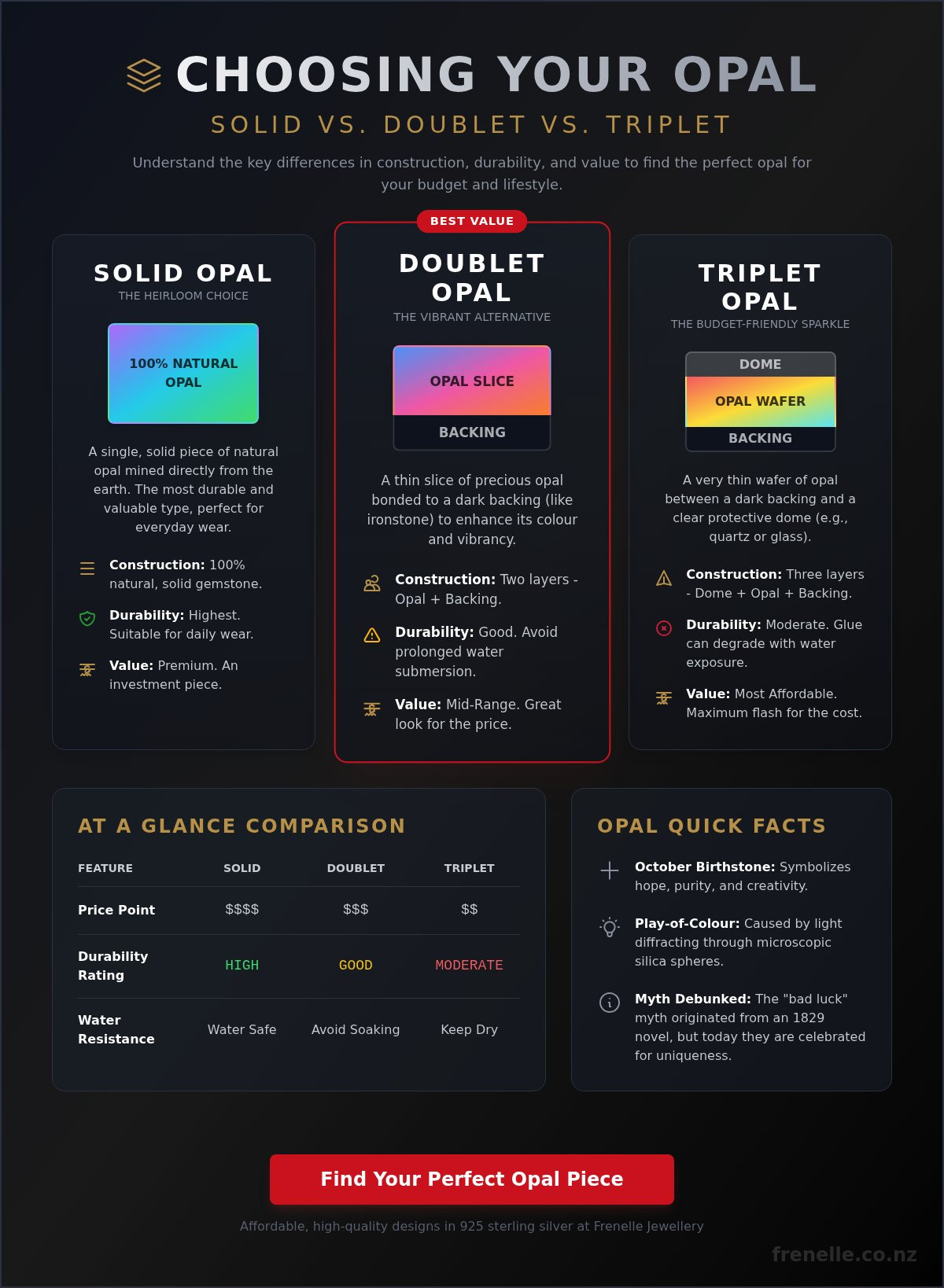
Solid stones consist of 100% natural opal mined from the earth. They represent the highest price point because they're rare and durable. You can wear a solid stone every day without worrying about layers separating over time. For those looking for deeper technical details on how these stones are graded, GIA's guide to opal quality factors explains how natural formations influence market value and rarity.
Enhanced stones provide a more budget-friendly alternative for Kiwi shoppers. Doublets feature a thin slice of opal attached to a dark backing, such as ironstone or black potch. This backing acts as a canvas, making the stone's "fire" pop with more intensity. Triplets go one step further by adding a clear protective dome, usually made of quartz or glass, over the top. While triplets are the most affordable, they require extra care. The glue between the layers can deteriorate if they're submerged in water frequently, so it's best to remove them before showering or swimming.
Natural opals take millions of years to form in the ground. In contrast, lab-created or synthetic stones are grown in controlled environments. They share the same chemical properties as natural stones but often display a "lizard skin" pattern that looks slightly too perfect to be real. Simulated opals are different again; these are typically made of glass or plastic and are common in very low-cost fashion jewellery. They don't have the same value as a stone pulled from the earth, but they offer a bright look for a fraction of the cost.
At Frenelle, we prioritize high-value 925 sterling silver settings for our collection. This metal provides a bright, neutral backdrop that allows the stone's internal colours to shine without the heavy price tag of solid gold. It's an ideal choice for New Zealanders who want quality jewellery that's still accessible for everyday use. Sterling silver is durable enough for the Kiwi lifestyle while remaining affordable for those shopping for gifts.
If you're looking for a gift that balances beauty with price, you might like to browse our carefully curated opal jewellery to find a style that fits your personal needs.
Choosing between an opal and a traditional diamond or moissanite involves balancing visual drama with daily durability. Diamonds are celebrated for their brilliance and fire, but they often look uniform in a crowded room. In contrast, an opal offers a shifting landscape of colour that changes with every movement of your hand. For many New Zealanders, the choice comes down to personality. A clear crystal is classic, but an opal is a conversation starter that feels deeply personal.
The visual impact of these stones couldn't be more different. Diamonds and moissanite rely on light refraction to create sparkle. An opal uses diffraction to produce a "play of colour" that can include flashes of neon green, deep blue, and fiery red. If you want a piece of jewellery that stands out in a sea of clear stones, opal is the clear winner. From a financial perspective, the initial investment for an opal pendant or ring is typically lower than a diamond of similar size. For shoppers in Auckland or Christchurch looking for a high-impact look without a five-figure price tag, this gemstone provides a path to luxury that feels both modern and attainable.
More Kiwis are exploring non-traditional wedding bands to express their unique style. The primary appeal of an opal wedding ring is its individuality; no two stones are ever identical. However, you must consider the Mohs Scale of Hardness. While a diamond scores a 10 and moissanite sits at 9.25, an opal is much softer at 5.5 to 6.5. This means it requires more intentional care to avoid scratches during daily activities. To ensure longevity, we recommend specific settings. A bezel setting, which wraps the metal entirely around the stone's edge, offers significantly better protection than a traditional prong setting. This "rub-over" style shields the edges from accidental knocks, making it a much safer choice for a ring you intend to wear every day.
Giving an opal as a gift shows a level of thought that generic clear stones often lack. As the traditional birthstone for October, it carries an immediate personal connection for many recipients. Its versatility is another major draw. Because opals contain multiple hues, they complement both gold and silver wardrobes with ease. They transition perfectly from a casual brunch in Ponsonby to a formal evening event. For budget-conscious buyers, the value proposition of opal lies in its ability to offer a high-end, bespoke appearance at a price point that remains accessible for meaningful gifting. It's a way to buy with confidence, knowing you're giving something as unique as the person receiving it.
Opals are unique in the gemstone world because they're non-crystalline silica containing between 3% and 21% water. This high water content makes them "living" stones that react to their environment. In New Zealand, our climate presents specific challenges. The high UV levels and salt-laden air in coastal areas like Auckland or Napier can affect the longevity of your jewellery if you don't take proper precautions. Maintaining the vibrant play-of-colour in your opal requires a balance of regular wear and careful storage.
Thermal shock is a real risk in the New Zealand winter. Moving your jewellery from a frosty 2°C morning in Queenstown to a room with a roaring fireplace can cause the stone to crack or "craze." Try to keep your jewellery against your skin to maintain a consistent temperature. Always remove your pieces before hitting the beach or the local pool. Saltwater is abrasive, and chlorine can damage the settings and the stone's surface polish.
Follow the "last on, first off" rule for your daily routine. Apply your perfumes, lotions, and hairspray before putting on your jewellery. These chemicals can dull the stone's surface over time. Since opals have a Mohs hardness of about 5.5 to 6.5, they're much softer than diamonds. They'll scratch if they come into contact with sand or household cleaners.
Many affordable pieces are doublets or triplets, which consist of a thin slice of stone glued to a backing. These are not "water-safe" because moisture can seep into the glue layer, causing the piece to turn foggy or grey. This damage is often permanent. For solid stones and 925 sterling silver settings, follow these steps to keep them sparkling:
Step 1: Use a soft, damp cloth to wipe the surface. Avoid ultrasonic cleaners at all costs. The high-frequency vibrations can cause internal fractures in a delicate opal and may even shake doublets apart.
Step 2: Dry the piece thoroughly with a lint-free cloth. Leaving a silver setting damp can accelerate tarnishing, especially in humid Kiwi summers.
Step 3: Store your jewellery in a separate soft pouch. This prevents harder gemstones like sapphires or quartz from scratching the face of your stone. If you live in a very dry climate, placing a small cotton ball dampened with a drop of water inside the storage box can help maintain the stone's hydration.
Ready to find a piece that lasts a lifetime? Browse our collection of affordable opal jewellery today.
Finding the right piece of jewellery should never feel like a cold or clinical transaction. At Frenelle, we've built our reputation on the idea that high-quality designs must be accessible and affordable. Dennis and Judy Wood started this family-owned business in Auckland to bridge the gap between overpriced traditional retail and low-quality imports. Every opal piece in our curated range is selected for its vibrant play of colour and lasting durability. We prioritize 925 sterling silver for our settings because it's naturally hypoallergenic. This makes our earrings and necklaces a safe, comfortable choice for New Zealanders with sensitive skin who often react to base metals like nickel or brass.
Our commitment to you is backed by our "Buy with Confidence" guarantee. We understand that buying jewellery online requires trust, so we ensure every customer feels supported throughout their journey. Whether you are looking for a gift or a personal treat, our collection offers the perfect balance of professional craftsmanship and personal warmth. We're proud of our Auckland roots and we always welcome feedback from our community to help us improve our service.
Choosing a local New Zealand boutique offers practical advantages that international giants simply can't match. We provide fast national shipping across the country, ensuring your order arrives quickly whether you're in Auckland, Wellington, or a rural RFD address. Shopping with us means you get:
As we look toward 2026, jewellery trends in New Zealand are shifting toward versatile elegance and pieces that tell a story. Minimalist opal studs are a top choice for everyday wear; they provide a subtle, iridescent glow that works perfectly for the office or a casual weekend brunch. These smaller pieces allow the natural fire of the stone to speak for itself without being overbearing. For those attending formal NZ events or weddings, statement pendants offer a sophisticated focal point that captures the light beautifully. You can Shop the Opal Collection at Frenelle to find a piece that resonates with your personal style and fits your budget.
Choosing the perfect piece of jewellery involves understanding how different stone types and settings fit your daily life. You now know how to distinguish between solid stones and triplets, and why 925 sterling silver is a durable choice for the unique New Zealand climate. Keeping your opal vibrant requires just a few simple maintenance steps to protect it from the humidity shifts we experience from Auckland to Invercargill. At Frenelle Jewellery, Dennis and Judy Wood believe that luxury should be accessible and stress-free. As a local family-owned and operated business, we stand behind every item with our Buy with Confidence guarantee. Our collection focuses on high-quality materials and timeless designs that suit any style. Whether you're celebrating an October birthday or simply treating yourself, we're dedicated to providing a boutique experience with a personal touch. You'll find that our commitment to quality and value makes it easy to find a piece you'll cherish for a lifetime.
Browse our stunning collection of affordable Opal Jewellery
Opals can be worn daily if you take specific precautions to protect them from hard knocks and scratches. These gems rank between 5.5 and 6.5 on the Mohs scale of mineral hardness, which means they're softer than stones like diamonds or sapphires. If you're wearing an opal ring for everyday tasks, choose a protective bezel setting that shields the edges of the stone from impact.
The idea that an opal brings bad luck is a total myth that stems from a 19th-century novel by Sir Walter Scott. Before this book was published in 1829, people viewed the stone as a symbol of hope and purity for thousands of years. Today, New Zealanders wear these stunning stones for their beauty regardless of their birth month, and there's no evidence to support any superstitious claims.
You should avoid getting your jewellery wet if it contains a doublet or a triplet stone. These specific pieces use a technical adhesive to bond different layers together, and water can cause that glue to deteriorate or turn the stone cloudy. While solid Australian stones aren't usually harmed by water, it's still best to remove your rings before swimming in chlorinated pools or using harsh household cleaning chemicals.
The main difference lies in how they react to moisture and their geological origin. Australian stones are mined from sedimentary rock and are generally very stable, while Ethiopian varieties are often hydrophane, meaning they can absorb water and change their appearance. Approximately 95% of the world's precious opal supply comes from Australia, offering a dense structure that's highly prized for its durability in the New Zealand climate.
You can identify a triplet by looking at the side of the stone for three distinct, horizontal layers. A triplet consists of a thin slice of genuine opal sandwiched between a dark backing and a clear quartz or glass dome. If you see a perfectly straight line where the clear top meets the colorful middle section, it's a triplet. Solid stones show a continuous, natural pattern from the top through to the back.
Your stone changes appearance because of a scientific phenomenon called play-of-color, where light diffracts through tiny silica spheres. Different light sources, such as bright Auckland sunlight versus warm indoor LED bulbs, hit these internal spheres at various angles. This causes the gem to flash different colors of the rainbow, making your jewellery look unique every time you move your hand or change rooms.
925 sterling silver is an excellent, high-quality choice for affordable jewellery that looks modern and bright. It's a very popular metal in the New Zealand market because it's hypoallergenic and complements the cool blue and green tones of the stone perfectly. While 14k or 18k gold offers more long-term durability for expensive engagement rings, sterling silver provides the best balance of value and beauty for everyday necklaces and earrings.
You can expect to pay between NZ$80 and NZ$250 for a quality sterling silver necklace featuring a lab-created or triplet stone in New Zealand. For solid natural stones, market prices typically start around NZ$400 and can exceed NZ$1,500 depending on the color intensity and carat weight. Always check the product specifications to ensure you're paying a fair price for the specific type of stone and metal being offered.