
0

Your Cart is Empty

Ultimate Guide to Choosing and Styling Jewellery Chains in 2026

by Frenelle Jewellery April 19, 2026 4 min read

Understanding the Foundations of Quality Jewellery Chains

Jewellery chains serve dual purposes: they act as standalone accessories and provide support for pendants. Understanding the intricacies of chain types is essential for making an informed choice.

  • When selecting a chain, consider the durability of materials, such as 925 Sterling Silver versus 18K Gold Plated base metals.
  • Pay attention to "tensile strength," which is crucial for the longevity of fine jewellery.
  • In 2026, trends are shifting toward "textured" chains, moving away from simplistic cable designs.

925 Sterling Silver: The NZ Standard

925 Sterling Silver, comprising 92.5% pure silver and 7.5% alloy, is the hallmark of quality in New Zealand. This composition not only provides durability but also makes it a hypoallergenic choice for sensitive skin. To ensure authenticity, familiarize yourself with the hallmark system that verifies your chain is genuine silver.

Gold Plating and Moissanite Accents

18K gold plating offers a luxurious aesthetic at an affordable price. Additionally, the popularity of moissanite-encrusted "tennis" style chains is on the rise, providing an everyday glamour that aligns with current trends. At Frenelle, we prioritize ready-to-wear durability over bespoke options, making our pieces both stylish and practical.

Jewellery Chain Style Dictionary

Understanding the various styles of jewellery chains is important in ensuring you are comfortable with the different designs and able to find the perfect one for your needs. Below we break down popular link types.

Classic and Sturdy: Curb, Belcher, and Cable

  • Curb Chains: These chains feature interlocking flat links, making them ideal for heavy pendants and masculine styles.

  • Belcher (Rolo) Chains: With their round links, Belcher chains are celebrated for their durability and versatility, making them a favorite for everyday wear. The individual links on  a rolo chain are round in shape and are slightly curved.

  • Cable Chains: The minimalist standard, cable chains are a staple in every jewellery collection due to their simple yet elegant design. On first glance cable chains can be confused with rolo chains.  But the links on cable chains are flat and not curved.  The links are also tend to be thiner than those on a rolo.

Decorative: Figaro, Snake, and Singapore

  • Figaro Chains: Characterized by a pattern of three short links followed by one long link, Figaro chains offer a unique visual that stands out.

  • Snake Chains: These sleek, tube-like chains require extra care to avoid kinking but provide a smooth aesthetic perfect for pendants.

  • Singapore Chains: The twisted link style of Singapore chains maximizes sparkle, ideal for those who love a bit of shine.

How to Choose the Perfect Chain Length and Thickness

Selecting the right length and thickness for your jewellery chain is vital for both comfort and aesthetics.
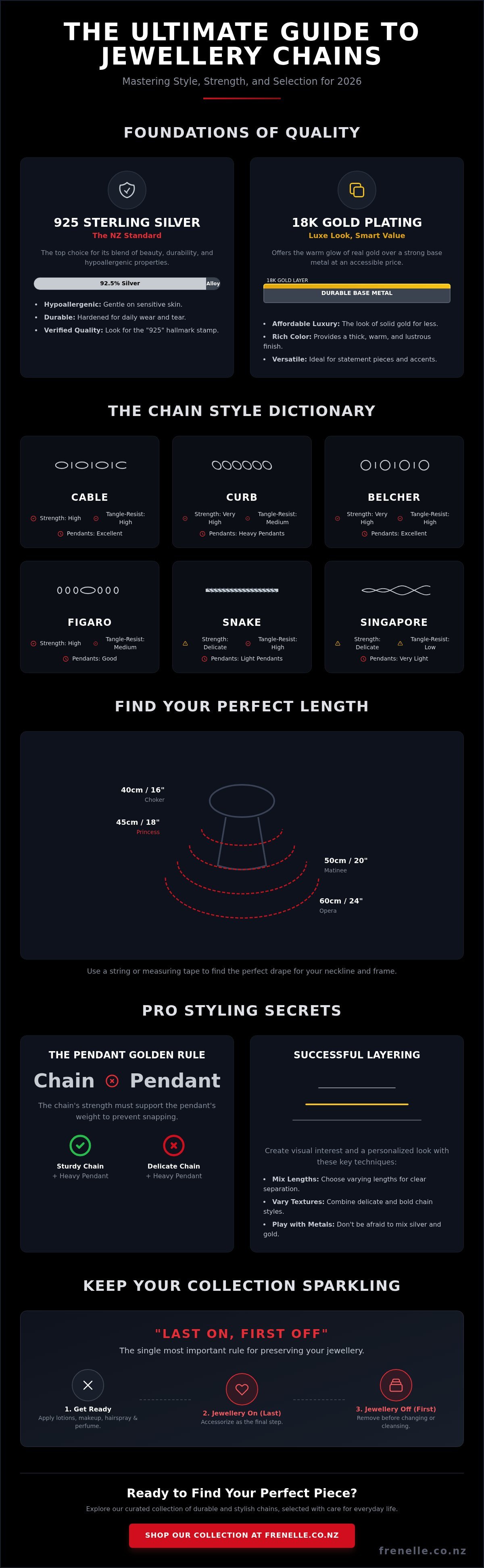
  • Start by measuring your neck size at home using a piece of string for an accurate fit.
  • Standard lengths range from 40cm to 60cm, with variations based on personal style and body proportions.
  • Choosing a chain thickness (measured in mm) should align with your body proportions and the weight of any pendants you plan to use.

The Length Guide for Every Neckline

  • 16-inch (40cm) "Choker" Style: Best suited for V-necks and off-the-shoulder tops.
  • 18-inch (45cm) "Princess" Length: This length is the most versatile, perfect for a variety of outfits. It is the most popular length that Frenelle Jewellery sells.
  • 20-24 inch (50-60cm) "Matinee" Length: Ideal for layering over knitwear or high collars.

Thickness and Weight Considerations

  • Fine Chains (1mm - 1.5mm): While elegant, these chains require careful handling to avoid breakage.
  • Medium Chains (2mm - 3mm): This thickness is the "sweet spot" for most medium-sized pendants, providing a balance between strength and style.
  • Heavy Chains (4mm+): Designed for statement pieces, heavy chains can be worn confidently without pendants.
Jewellery chains

How to Pair Chains with Pendants and Layer Successfully

Pairing chains with the right pendants and mastering layering techniques can elevate your jewellery game.

  • The golden rule of pendant weights: your chain must be at least as heavy as the pendant to avoid breakage.
  • Matching metal colours creates a cohesive look, while the modern trend of "mixed metal" can add interest.
  • Utilizing magnetic clasps can simplify the process of putting on and taking off your chains.

Art of Pendant Pairing

  • Choose the right bail size to ensure it fits through your pendant seamlessly.
  • Box chains, known for their smooth glide, make excellent choices for sliding pendants.
  • Factor in the length of your pendant.  A long pendant may require a shorter chain to enable the pendant to sit in the right place below your neck.

Layering Techniques for 2026

  • Stick to the "Three-Length Rule" for perfect spacing when layering chains.
  • Mix textures by pairing a flat curb chain with a sparkly zingapore chain for visual interest.
  • Chain extenders can help customize your existing collection for a perfect fit. Click HERE to see the options available.

Caring for Your Chains: Preventing Tarnish and Damage

Taking care of your jewellery chains is essential for maintaining their beauty and longevity.

  • Understanding why silver tarnishes in New Zealand's unique climate can help you slow down the process.
  • Follow the "Last On, First Off" rule when wearing jewellery to preserve its shine.
  • Proper storage is crucial; hanging chains is preferable to a cluttered jewellery bowl.  Detangling knotted chains is time-consuming and frustrating.

Tarnish Prevention in the NZ Climate

  • Salt air and humidity can accelerate oxidation on sterling silver, so take precautions.
  • Utilizing airtight storage and anti-tarnish strips can help preserve the shine of your jewellery.
  • Tarnish is a natural chemical reaction and not a sign of poor quality, so don’t be annoyed with your supplier if your chain does tarnish.

How to Safely Untangle a Fine Chain

  • The "Two Needle" technique can be effective for loosening stubborn knots on a flat surface.
  • Avoid pulling on knotted chains, as this can stretch and damage the links.
  • Consider using magnetic clasps to prevent tangling when putting on or taking off jewellery.  Frenelle sells a range of magnetic clasps which can be viewed by clicking HERE